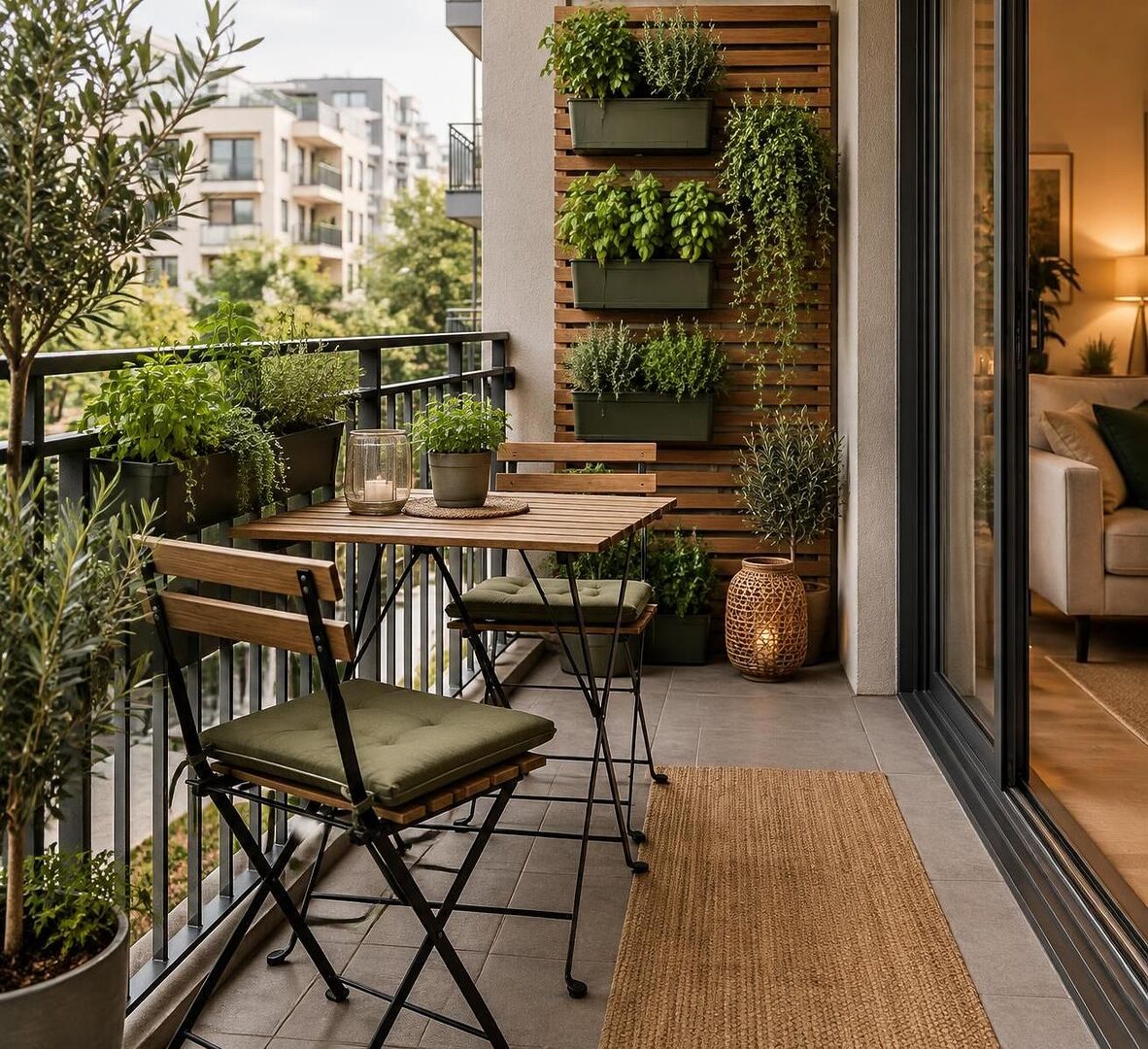
An urban balcony can function as an outdoor room, even when it is only wide enough for a chair and a planter. The difference between a cramped landing and a useful retreat usually comes down to planning: measure the space, decide how it should support daily life, and choose pieces that earn their footprint. With a thoughtful layout, small-space design can make room for morning coffee, container gardening, reading, or a quiet place to step outside.
Start with the balcony’s real constraints, not an idealized furniture arrangement. Door swings, railing height, sun exposure, wind, drainage, building rules, and the amount of usable floor area all shape what will work. A narrow balcony may call for foldable furniture and rail planters; a deeper one might accommodate compact seating and a small dining table. The goal is an urban oasis that feels connected to the home without blocking access, airflow, or safe movement.
In brief
- Measure the usable floor area and keep the route to the door clear.
- Choose multifunctional furniture that can fold, stack, or provide storage.
- Use vertical gardening and rail planters to add greenery without sacrificing floor space.
- Improve balcony privacy with screens or plants, while preserving light and airflow.
- Select outdoor lighting and weather-resistant decor suited to the balcony’s exposure and building requirements.
Plan an Urban Balcony Layout Around Everyday Use
A successful balcony makeover begins with an honest assessment of how the space will be used. A resident who wants a place for breakfast has different needs from someone hoping to grow herbs or stretch outdoors. Trying to fit every possible function into a small footprint often produces the least useful result: furniture becomes hard to move around, and the balcony starts to feel like storage rather than living space.
Measure the width and depth, then note fixed features such as the door, outlets, downspouts, vents, and railings. Include the clearance needed to open the door fully. In a narrow layout, a table placed directly in the doorway’s path can make the entire balcony awkward, even if it looks attractive in a product photo.
It helps to sketch the floor plan before purchasing anything. Mark a clear walking route and identify one primary activity. If a resident named Maya has a shallow balcony and wants a coffee spot, a small folding table clipped or placed near the railing and two folding chairs may serve her better than a full lounge set. The furniture can be put away when she needs open floor space for watering plants or cleaning.
Choose a focal point without crowding the view
A focal point gives a compact outdoor area a sense of purpose. It might be a comfortable chair, a row of herbs, a sculptural planter, or a simple café table. Keeping the rest of the design restrained helps that feature stand out. Repeating a small number of materials and colors also makes a limited area feel more cohesive.
Think vertically as well as horizontally. A slim shelving unit, wall-mounted planter, or trellis can use an overlooked surface, provided the installation is permitted and secure. However, vertical features should not cover vents, interfere with neighboring windows, or create a hazard in high winds. In multifamily buildings, residents should check lease terms, HOA documents, and property rules before attaching anything to walls or railings.
Balconies also connect to a home’s architecture. For inspiration on how outdoor spaces relate to building form, see these balcony design ideas for two-story homes. The useful lesson is not to copy a larger property’s layout, but to carry a consistent visual language from indoors to outdoors. A balcony that feels like a natural extension of the living room is more likely to be used regularly.
Planning the circulation first prevents expensive trial and error. In a compact space, a clear route and one well-chosen purpose are more valuable than a long list of features.
Use Multifunctional Furniture and Storage to Save Floor Space
Furniture has an outsized effect on a small balcony because every piece occupies a meaningful share of the available floor. The right choice is not necessarily the smallest item; it is the one that supports the intended activity without creating obstacles. Multifunctional furniture can provide seating, storage, and flexibility in one footprint, while foldable furniture allows the layout to change from one use to another.
A storage bench is a practical example. It can hold gardening tools or removable cushions while providing a place to sit. Before buying, check its dimensions against the balcony and consider whether the lid can open without hitting a wall or railing. A folding table is useful for dining or working outdoors, then can be lowered or stored when the surface is not needed. Stackable chairs are another sensible option for occasional guests.
Match furniture to the balcony’s proportions
Scale matters as much as function. A deep lounge chair may be comfortable but leave no room to pass, while a narrow café chair can make a balcony usable without overwhelming it. Measure the footprint of each item, including space to pull a chair out. If a furniture set requires the entire floor to be occupied before anyone can sit comfortably, it is likely too large.
Consider how much maintenance each material requires. Metal frames can be durable, but the finish and hardware need to suit outdoor exposure. Wood can add warmth, though it may require periodic care depending on its type and finish. Resin wicker and other outdoor-rated synthetics can offer a lighter visual effect, but quality and weather performance vary. Manufacturer care instructions are a better guide than assumptions based on appearance alone.
Storage should keep the space organized without making it feel enclosed. A compact deck box or bench can hide small items, while wall shelves keep lightweight accessories off the floor. Avoid overloading shelves or attaching heavy objects without confirming that the wall and fasteners can support them. In a rental, freestanding solutions are often easier to remove and less likely to conflict with property rules.
Design for more than one routine
Flexible furniture allows a balcony to adapt through the day. A small table can hold a laptop in the morning and a meal later; two chairs can become extra seating when guests visit. If the balcony doubles as a stretching area, choose pieces that can be moved quickly and stored safely. A few deliberate choices make these transitions easier than filling the balcony with single-purpose items.
There is a trade-off: folding pieces may sacrifice some stability or comfort compared with heavier fixed furniture, and storage furniture takes up space even when its contents are hidden. Test mechanisms, inspect weight limits, and consider how often the furniture will be moved. A well-designed arrangement is not the one with the most features; it is the one that makes ordinary routines simple.
When each item has a clear job and can be moved or used in more than one way, a modest balcony can remain open, practical, and comfortable.
Bring in Greenery with Vertical Gardening and Container Gardening
Plants can soften hard surfaces, create a sense of separation, and make a balcony feel more connected to the outdoors. They do not need to take over the floor. Vertical gardening uses walls, shelves, trellises, and hanging containers to put greenery at different heights, while container gardening lets residents grow plants in pots suited to the available light and space.
Before selecting plants, observe the balcony over several days. Note how many hours of direct sun reach it and whether wind funnels between nearby buildings. A bright, exposed balcony may suit different plants from a shaded one protected by neighboring structures. Local garden centers and university extension services can help identify species suited to regional conditions; a plant that thrives in one climate may struggle in another.
Use height and repetition to make a small garden feel intentional
Try a simple layered arrangement: taller plants near a corner or wall, medium containers along a railing, and a few smaller pots on a table or shelf. Repeating the same planter finish can keep the display orderly even when the foliage varies. Herbs such as basil or mint can be useful if their light and watering needs match the conditions, but mint is often easier to manage in its own container because it spreads vigorously.
Rail planters can preserve floor area, but they must be compatible with the railing and securely installed. Some buildings restrict items attached to balcony rails, and unsecured containers can fall or spill during storms. Use saucers or drip trays where appropriate, and confirm that watering will not drain onto neighbors below. These basic checks protect the building as well as the plants.
Vertical systems also need practical access. A dense wall of pots can look striking, yet become difficult to water, prune, or inspect. Leave room to reach each container and check that shelving or a trellis is rated for the combined weight of the planters, soil, and water. Wet growing media is heavier than dry media, so lightweight construction should not be mistaken for low load.
Balance privacy, light, and airflow
Plants can contribute to balcony privacy without creating a solid wall. A trellis with climbing plants, a few taller containers, or a staggered arrangement can soften direct sightlines while allowing light and air to pass through. The right approach depends on the building’s exposure and rules; a dense screen may block a desirable breeze or reduce daylight inside the apartment.
For example, a resident facing a nearby building could position a narrow planter and trellis along one side rather than enclosing the whole railing. This creates a more sheltered seating corner and retains an open view elsewhere. Choose species and containers that can tolerate local weather, and plan for seasonal care before filling every available surface.
A manageable collection of well-placed plants can bring the benefits of a garden to an urban home without making the balcony harder to maintain.
Choose Outdoor Flooring, Lighting, and Weather-Resistant Decor
Surface finishes and accessories give a balcony its visual character, but outdoor conditions should guide every choice. Sun, rain, temperature swings, and wind can damage materials designed for indoor use. Weather-resistant decor is typically easier to maintain, though product claims and performance differ, so review care instructions and warranty terms rather than relying on a label alone.
Outdoor rugs can define a seating area and soften a hard floor, but they should not block drains or retain water against the surface. Interlocking deck tiles may change the appearance of a concrete balcony, yet the building may restrict modifications, and the substrate still needs to drain properly. Any flooring treatment should be removable or approved where required, and it should not create a raised edge that becomes a tripping hazard.
Build a consistent palette
In a small area, a limited color scheme usually feels calmer than many competing finishes. Natural wood tones paired with cream or white can brighten a shaded balcony; charcoal and muted green may complement a more contemporary façade. Colorful cushions or planters can add personality without committing to a large, permanent feature.
Texture adds interest when the palette stays restrained. A woven chair, a ceramic planter, and a simple outdoor rug can provide contrast without clutter. Keep fabrics easy to remove and store, especially in regions with heavy rain or strong sun. Cushions left outdoors year-round may fade or retain moisture, even when made for exterior use.
Plan outdoor lighting for comfort and practicality
Outdoor lighting can extend the useful hours of a balcony and make it more inviting after sunset. Battery-powered lanterns or properly rated string lights offer flexible options where outlets are unavailable, while fixed fixtures may need approval from the property owner or building association. Follow the manufacturer’s instructions for outdoor use and keep cords away from doorways and drainage areas.
Warm, modest illumination often works better than a bright flood of light in a small setting. A lantern on a table can provide enough light for a quiet meal, while low-level lighting near the seating area helps define the space. Consider neighboring windows when choosing brightness and placement; a comfortable balcony should not cast glare into other homes.
Before purchasing, check whether the fixture is intended for outdoor exposure and whether its power source suits the location. Solar products depend on receiving adequate sunlight, which can be limited by shade from surrounding buildings. A mix of portable, low-intensity lights may be more reliable than installing several fixtures that are difficult to access or maintain.
Thoughtful finishes should withstand ordinary exposure while supporting the balcony’s purpose. Durable choices and restrained lighting create atmosphere without adding unnecessary upkeep.
Make a Balcony a Flexible, Comfortable Extension of Home
A balcony works best when its design reflects the way residents actually live. Some people want a quiet reading corner; others prioritize a place to eat outside, tend herbs, or sit with a guest. A multi-purpose layout can support more than one activity, but it should remain easy to reset. One open patch of floor is often more useful than another decorative object.
Start with the activity that matters most, then add compatible features. For a reading area, compact seating, a small side table, and soft lighting may be enough. For outdoor meals, a foldable table and two chairs can serve daily use without permanently taking over the floor. Someone who practices yoga may prefer movable planters at the edges and furniture that can be folded or stacked.
Account for safety and building requirements
Before installing a swing chair, hanging planter, privacy panel, or heavy planter, check the balcony’s structure and the building’s rules. Suspended seating places loads on its mounting point, and not every ceiling or railing is designed for that purpose. Likewise, a large container filled with wet soil can be substantially heavier than it appears when empty. When a project involves drilling, electrical work, or structural attachment, obtain the necessary property approval and qualified guidance.
Keep exits and access paths clear, and avoid placing objects where they could be knocked over or blown away. Open flames, portable heaters, grills, and fire pits may be prohibited or restricted by a lease, HOA, local fire code, or building policy. Requirements vary, so residents should verify applicable rules rather than assume that a product marketed for outdoor use is permitted on every balcony.
Maintain the space through changing seasons
Regular care preserves both appearance and function. Sweep leaves and dirt, inspect planters for drainage, and check furniture joints and light fixtures from time to time. Store or secure cushions before severe weather, and reposition plants when seasonal changes affect their light exposure. A small routine is easier than waiting until clogged drains or damaged finishes require a larger repair.
Consider how the balcony looks from inside the home, too. Matching one or two colors with the interior can make the outdoor area feel like an extension of the living room, while a contrasting accent keeps it distinct. Architectural references can help clarify this relationship; these modern exterior design ideas offer examples of coordinated materials and visual details across a home’s exterior.
Balcony design can contribute to a home’s appeal by making an existing outdoor feature more usable, but no design choice guarantees a particular change in property value. Buyers may appreciate a clean, functional balcony, while the effect on marketability depends on the home, neighborhood, condition, and buyer preferences. The soundest investment is a design that improves everyday use and remains easy to maintain.
When comfort, safety, and flexibility guide the decisions, even a modest balcony can become a genuinely useful part of the home.
| Balcony priority | Space-conscious option | Practical point to check |
|---|---|---|
| Dining or coffee | Folding café table and compact chairs | Allow space for the door and chair movement |
| Greenery | Wall shelves, rail planters, or a narrow trellis | Confirm secure installation, drainage, and building rules |
| Storage | Bench with concealed storage | Check lid clearance and weather exposure |
| Evening use | Outdoor-rated portable lanterns or string lights | Follow electrical and property requirements |
| Privacy | Staggered plants or an approved open screen | Preserve airflow and avoid unsecured panels |
How can a very small urban balcony feel larger?
Keep a clear path to the door, use compact or foldable furniture, and move some storage and planting upward with shelves or vertical gardening. A restrained color palette and limited number of large pieces can also make the area feel less crowded.
Which furniture works best on a narrow balcony?
Folding chairs, a slim table, stackable seating, and storage benches are useful options. Measure the balcony and account for chair movement and door clearance before buying.
How can balcony privacy be improved without blocking airflow?
Use a partial screen, trellis, or staggered tall planters along the most exposed side instead of enclosing the entire railing. Check building rules and secure all additions against wind.
What should residents check before adding planters or hanging chairs?
Review lease or HOA requirements, confirm that attachments are permitted, and consider the weight of wet soil or suspended seating. Keep drainage directed appropriately and seek qualified guidance for structural installations.

At 33 years old, I specialize as a Licensed Residential Real Estate Advisor and Property Market Analyst. With a deep understanding of market trends and client needs, I provide strategic insights and personalized guidance to help clients make informed real estate decisions.