At 200 Larkin St, a former public library becomes a gateway to Asian art, civic architecture, and the layered neighborhood life of San Francisco. The Asian Art Museum anchors the address, but the experience extends beyond its galleries: Civic Center landmarks, public transit, nearby cultural institutions, and the Tenderloin’s distinctive food and arts scene make the surrounding blocks part of the visit. For travelers seeking more than a checklist of familiar attractions, this is a place where a museum outing can turn into a broader urban experience.
In 2026, the address also sits within a changing corridor. Larkin Street Revival, a partnership-driven initiative planned in phases beginning early in the year, aims to improve the stretch from Fulton to Post through lighting, storefront activity, expanded stewardship, and support for cultural uses. These efforts are intended to complement—not replace—the businesses and communities already giving the street its character. Together, the museum’s history and the neighborhood’s evolving plans help explain why 200 Larkin St is a unique destination for travel, local culture, architecture, and city exploration.
In Brief: What Makes 200 Larkin St a Unique Destination
- The Asian Art Museum occupies the former San Francisco Main Public Library, a Beaux-Arts landmark completed in 1917 and adapted for museum use.
- The collection spans Asian regions and artistic traditions, linking historic objects with contemporary perspectives.
- Civic Center location makes the museum part of a wider circuit of public buildings, performance venues, plazas, and neighborhood attractions.
- Larkin Street Revival is planned as a phased public-private effort to improve visibility, support businesses, and activate cultural uses along the corridor.
- A well-planned visit pairs museum time with attention to current transit, admission, accessibility, and event information.
200 Larkin St and the Asian Art Museum: A Civic Center Starting Point
The address at 200 Larkin St is best understood as more than a museum location. It sits in San Francisco’s Civic Center, where cultural institutions and public buildings create a walkable framework for exploring the city’s civic life. The Asian Art Museum is near City Hall, the San Francisco Public Library, and major performance venues, so visitors can build a day around several destinations rather than treating the museum as an isolated stop.
That context matters for travelers who want a more textured city exploration. A museum visit can begin with the building and galleries, continue through Civic Center Plaza, and then lead toward nearby food, performances, or the distinct commercial streets of the Tenderloin. The transition from formal civic spaces to neighborhood storefronts is part of the experience: San Francisco is not presented as one uniform postcard, but as a collection of adjoining places with different histories and daily rhythms.
Transit access is another practical advantage of the location. The Civic Center/UN Plaza area is served by regional and local public transportation, although routes, service conditions, and station access can change. Visitors should check current transit information before setting out, especially when coordinating a timed museum entry or an evening event. Those arriving by car should also confirm current parking options and costs rather than assume that a nearby garage will have space.
How to Plan a Neighborhood Visit
Consider a first-time visitor who has a few hours in the city and wants an outing that combines art with a sense of place. Rather than racing through every gallery and then leaving immediately, that visitor might reserve time for the museum, pause in the surrounding civic district, and choose a nearby meal or cultural event. This slower approach makes the street network part of the itinerary and allows room for unexpected discoveries.
It is also sensible to make decisions based on the day’s conditions. Museum hours, ticket policies, special exhibitions, public programs, and nearby events can vary, so the institution’s official visitor information is the appropriate source for current details. If the visit includes several nearby venues, check each one separately; a civic building, museum, and performance space may follow different schedules.
- Before leaving: confirm museum hours, admission details, and any timed-entry requirements.
- For the route: review current public transit service and accessible station information.
- For a longer outing: identify a few nearby destinations, but leave time to explore without rushing.
- For evening plans: check event schedules and consider how the route will work after dark.
The location’s strength is not simply convenience; it is the way several layers of San Francisco meet within a compact area. That civic setting leads naturally to the story told by the building itself.
Architecture at 200 Larkin St: From Public Library to Art Museum
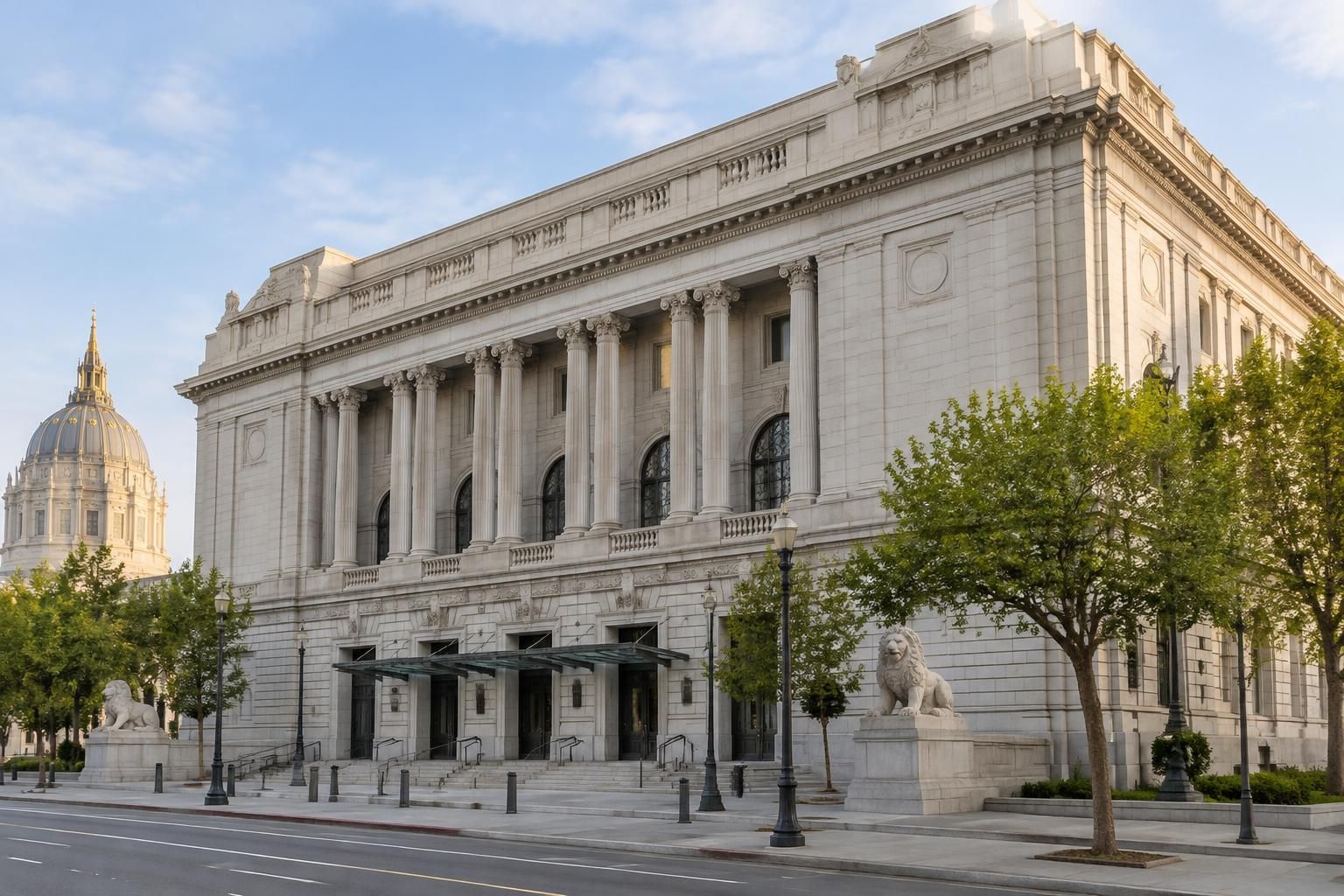
Before visitors encounter an artwork, they encounter a building with its own civic history. The structure at 200 Larkin St originally served as San Francisco’s Main Public Library and was completed in 1917. Its Beaux-Arts character reflects an era when public institutions used monumental scale, formal composition, and carefully finished architectural details to express permanence and public purpose.
Its later conversion into the Asian Art Museum offers a useful example of adaptive reuse: giving an existing building a new function while retaining important elements of its earlier identity. The museum’s move from Golden Gate Park to Civic Center created an opportunity to expand its exhibition and public spaces while bringing the institution into a more central urban setting. The museum opened at the Larkin Street address in 2003 after a redesign led by Italian architect Gae Aulenti, known for work that reimagines historic structures for contemporary use.
Design That Connects Old and New
Aulenti’s approach worked with the building’s history rather than treating it as an empty shell. The former interior courtyard was transformed into a tall, light-filled atrium that now serves as a memorable point of arrival. Original architectural features—including grand staircases and historic details—sit alongside contemporary galleries, display systems, and lighting designed for the care and presentation of art.
For a visitor, that combination offers a clear lesson in how architecture shapes movement. The atrium provides orientation and a sense of scale before the galleries narrow attention toward individual objects. A historic staircase can remind visitors of the building’s former public role, while modern exhibition spaces support different conservation and viewing needs. The result is not a simple recreation of the old library or a completely detached new museum; it is a layered setting in which both histories remain legible.
The building’s civic character also complements the museum’s mission. A former library was designed to welcome the public and support learning; a museum similarly invites observation, research, and exchange. The transition from books and reading rooms to art and cultural interpretation changes the contents but preserves a shared idea: a public institution can make knowledge accessible through a physical place.
Why the Building Matters to Visitors
Architecture is especially valuable for travelers who may not have a specialist background in Asian art. The building gives them an immediate point of entry. They can notice how natural light changes the atrium, how older details frame contemporary displays, and how the route through the galleries influences the pace of a visit. These observations make the experience richer without requiring technical knowledge.
The address also places the museum within a broader architectural conversation. Civic Center’s public buildings show how San Francisco has represented government, education, and culture through monumental design. Walking between them makes it possible to compare styles and purposes at street level, rather than seeing each structure only in photographs. For anyone interested in architecture, the museum is both a destination and a starting point for reading the surrounding district.
In this way, the former library is not merely a container for collections. Its transformation shows how an established city can preserve a landmark while adapting it to new public needs, a principle that remains relevant to conversations about San Francisco’s built environment.
Asian Art Museum Collections: A Broad View of History and Culture
The Asian Art Museum’s galleries give 200 Larkin St its strongest cultural draw. Its collection brings together objects from across Asian regions and spans thousands of years, allowing visitors to encounter different materials, beliefs, artistic methods, and historical settings under one roof. The experience is not just a sequence of beautiful objects. It is an opportunity to see how art can record spiritual practice, political authority, trade, technological change, and everyday life.
Regional groupings help visitors orient themselves. Galleries include art associated with East Asia, South Asia, Southeast Asia, the Himalayan region, and West Asia. That organization can make a first visit more manageable, but it also invites comparison. A visitor looking at sculpture in two different galleries, for example, may notice how religious ideas travel while local materials and visual conventions produce distinct forms.
Historic Objects and the Stories They Carry
Chinese art offers examples of how craftsmanship and symbolism meet. Ancient bronze vessels demonstrate sophisticated metalworking and ritual use, while jade objects reveal the cultural significance attached to a material valued for its appearance and associations. Ceramics trace changing techniques and tastes across periods, and paintings and calligraphy show how brushwork, poetry, and landscape can function as both artistic expression and intellectual practice.
Japanese galleries introduce another range of forms, including screens, scrolls, lacquerware, ceramics, and woodblock prints. A screen may organize a room while presenting a carefully composed image; a tea bowl can express a preference for material character and restrained form. Woodblock prints, in turn, offer a view of popular culture and urban life in historical Japan. These works are especially helpful for visitors who want to connect art with the settings and audiences for which it was made.
Across South and Southeast Asia, sculpture and ritual objects often communicate religious narratives through posture, gesture, and attributes. Himalayan and Tibetan works may include thangka paintings and finely made sculpture associated with Buddhist practice. West Asian art can reveal the importance of calligraphy, geometric design, ceramics, and manuscript painting. Each regional grouping contributes a different visual vocabulary, and the museum’s breadth encourages visitors to consider both difference and exchange.
Connecting Historical Art to Contemporary Expression
The collection and programming are not limited to antiquity. Contemporary Asian and Asian American art can bring present-day questions of identity, migration, globalization, and social change into conversation with older traditions. This connection matters because cultural heritage is not static. Artists interpret inherited forms, respond to current circumstances, and create work that reflects lives shaped by movement across regions and generations.
For example, a visitor might first encounter a historical object whose function is unfamiliar, then see a contemporary work that uses a related visual reference in a new context. The contrast can prompt better questions: what changes when an image moves from a ritual setting to a gallery, or when an artist revisits a traditional technique to address a modern experience? Museums cannot answer every question with a label, but they can create settings in which informed looking becomes possible.
Special exhibitions and public programs add another layer, although their subjects and schedules change. Checking the museum’s current calendar helps visitors decide whether a temporary show should shape the day’s plan. The permanent collection supplies continuity; rotating exhibitions introduce new points of view. Together, they make the museum a destination that can reward repeat visits as well as a first-time stop.
The collection’s defining strength is its capacity to make a large and diverse region approachable without suggesting that one visit can represent every culture. A thoughtful visit begins with curiosity, then allows individual objects and their contexts to complicate first impressions.
Larkin Street Revival and the Neighborhood Attractions Around 200 Larkin St
The museum’s setting cannot be separated from the Tenderloin and the wider Larkin Street corridor. Larkin is both a commercial street used by neighborhood residents and a route through an area with a strong cultural identity, including Southeast Asian and immigrant heritage. For visitors, this means the urban experience extends beyond museum walls: food businesses, cultural organizations, storefronts, public spaces, and everyday neighborhood activity all contribute to the character of the district.
In 2026, Larkin Street Revival is planned as a phased, partnership-driven effort focused on the stretch from Fulton to Post. The initiative is intended to support the corridor’s role as a gateway to the Tenderloin’s International District and to advance priorities associated with the 2025 Tenderloin Community Action Plan. Its stated approach combines visible physical improvements with policy and business-support efforts rather than relying on a single intervention.
What the Corridor Initiative Is Designed to Do
The initiative is supported by an initial two-year private investment of $5 million along with multi-year funding from San Francisco’s Office of Economic & Workforce Development. The funding framework is intended to help bring near-term changes to the street while supporting a longer effort to strengthen commercial and cultural activity. The exact sequence and timing of individual projects may vary as implementation proceeds.
Planned actions include lighting enhancements, creative installations in vacant storefronts, pop-up programs, and efforts to attract anchor arts and entertainment organizations. The program also describes expanded cleaning operations, enhanced safety coverage, and targeted support for businesses. These measures address different parts of the corridor’s experience: lighting and active storefronts affect visibility, while stewardship and business support relate to how the street functions over time.
For an example, imagine a visitor arriving for an afternoon museum visit and later looking for a meal nearby. An active storefront or cultural pop-up can make that walk feel more connected to the district’s identity, while lighting and ongoing maintenance influence how public space is experienced after daylight hours. Such improvements do not erase the neighborhood’s existing challenges, nor do they guarantee a particular outcome. Their value depends on steady coordination with residents, businesses, and local institutions.
| Corridor element | Planned approach | Why it matters to visitors and neighbors |
|---|---|---|
| Storefront activity | Creative installations, pop-ups, and efforts to reduce vacancies | Can bring more visible cultural and commercial activity to the street |
| Arts and entertainment | Support for cultural events and potential anchor organizations | Connects the corridor’s heritage with new reasons to visit |
| Street conditions | Lighting improvements, cleaning, and enhanced stewardship | Influences visibility, upkeep, and the everyday experience of public space |
| Business support | Targeted assistance and policy-process work | Recognizes that lasting vitality depends on established and emerging businesses |
For city exploration, the practical lesson is to approach the neighborhood with curiosity and consideration. A visitor can support local businesses, follow posted guidance, and avoid treating residents’ daily surroundings as a backdrop. The corridor’s cultural appeal is strongest when the people and organizations already rooted there remain central to its future.
Larkin Street Revival also aims to inform policy and process changes that could support new ground-floor uses, including creative retail and music or entertainment venues. That broader goal reflects a useful urban principle: a vibrant street is shaped not only by its buildings, but by what happens at sidewalk level and by whether local enterprises can participate in that activity.
Visitor Guide to 200 Larkin St: Making the Most of the Trip
A rewarding visit does not require an elaborate itinerary, but a little preparation can help travelers use their time well. Start with the museum’s official visitor information for current hours, admission, special exhibition policies, accessibility details, and public-program schedules. These specifics can change, and current information is more useful than relying on an old travel listing or an undated review.
Next, decide what kind of day you want. Someone with a strong interest in art history may spend most of the visit in selected galleries, reading labels and comparing objects. A family might focus on a few rooms, seek out interactive interpretation, and build in a break. A visitor with only limited time can choose two or three areas of interest rather than attempting to see everything at speed.
A Practical Visit Sequence
Begin by taking in the building’s central atrium and considering its earlier life as a public library. That first pause helps establish the architectural context before attention shifts to individual works. Then choose a regional route through the galleries, using the floor plan and any current visitor guidance to focus on the subjects that interest you most.
Audio resources, guided tours, and digital interpretation may be available, but offerings vary by date and exhibition. They can be particularly useful when a work’s materials, symbolism, or historical role are unfamiliar. A short explanation of how an object was made or used can transform a quick glance into a more meaningful encounter, much as a map can change an unfamiliar street into a navigable neighborhood.
Leave room in the schedule for rest and reflection. Museums contain a great deal of visual information, and a brief pause can help visitors absorb what they have seen. If the museum has a café or store operating during the visit, these may provide convenient breaks, but current services should be confirmed before arrival.
Balancing the Museum with City Exploration
After the galleries, consider spending time around Civic Center and choosing nearby attractions according to your interests. The area’s public buildings, performance spaces, and plazas offer architectural and cultural context, while surrounding commercial streets provide a closer view of everyday San Francisco. Event programming and street conditions can differ from one day to another, so flexibility is useful.
Accessibility planning deserves the same care as scheduling. The museum has public visitor facilities, but anyone requiring a particular accommodation should consult the institution directly for current details. For transit, check service information and station access; for driving, confirm parking availability and any restrictions. These small steps reduce the chance that logistics will crowd out the cultural experience.
Ultimately, 200 Larkin St works best as a starting point rather than a box to check. The museum brings history, art, and architecture together, while the surrounding district adds the texture of a living city. Visitors who allow time for both are more likely to leave with a stronger sense of how San Francisco’s cultural institutions and neighborhoods connect.
What is located at 200 Larkin St in San Francisco?
The Asian Art Museum is located at 200 Larkin St in San Francisco’s Civic Center. The address is also near other civic and cultural destinations, making it a useful starting point for exploring the district.
What makes the Asian Art Museum building notable?
The museum occupies San Francisco’s former Main Public Library, a Beaux-Arts building completed in 1917. Architect Gae Aulenti led its transformation for museum use, combining historic features with contemporary gallery spaces.
What is Larkin Street Revival?
Larkin Street Revival is a phased public-private initiative focused on the Larkin Street corridor from Fulton to Post. Planned elements include lighting, storefront activation, cultural programming, cleaning, safety coverage, and business support.
How should visitors plan a trip to 200 Larkin St?
Check the Asian Art Museum’s official information for current hours, tickets, exhibitions, accessibility, and programs. Review transit or parking details as well, then allow time to explore the Civic Center and nearby neighborhood attractions.

At 33 years old, I specialize as a Licensed Residential Real Estate Advisor and Property Market Analyst. With a deep understanding of market trends and client needs, I provide strategic insights and personalized guidance to help clients make informed real estate decisions.