
Capri’s most memorable hotels do more than provide a place to sleep: they shape how the island feels. A stay near the Piazzetta puts cafés, boutiques, and evening passeggiata within easy reach, while a property in Anacapri offers a quieter base with a different perspective on the island’s rugged interior. Along the southern cliffs, terraces and pools can turn the Faraglioni sea stacks into part of the daily view. Choosing among Capri accommodation options therefore means weighing location, atmosphere, access, and the kind of experience wanted—not simply comparing room categories.
Among the island’s standout luxury hotels are historic grande dames, intimate boutique hotels, and refined retreats designed around Mediterranean views. Grand Hotel Quisisana and Hotel La Palma suit travelers who want to stay close to Capri town’s social heart; Hotel Caesar Augustus and Capri Palace in Anacapri offer a more secluded setting; and Punta Tragara and La Scalinatella bring coastal elegance to the island’s dramatic southern side. Each property has its own strengths, from sea-view suites and polished Italian hospitality to privacy, design, and historic charm. The right choice depends on whether the priority is convenience, quiet, scenery, or a blend of all three.
In Brief: Choosing Among Capri’s Luxury Hotels
For a central base: Grand Hotel Quisisana and Hotel La Palma place guests near Capri town’s shops, restaurants, and Piazzetta.
For elevated scenery: Hotel Caesar Augustus, Punta Tragara, and La Scalinatella are known for settings that make the island’s coastal landscape central to the stay.
For a quieter retreat: Capri Palace in Anacapri offers a more removed atmosphere than properties near the town center.
For a personal feel: Smaller hotels and private villas may appeal to travelers who value privacy and a less formal rhythm.
Before booking: Compare location, seasonal opening dates, room orientation, transfer arrangements, and what is included in the quoted rate.
Grand Hotel Quisisana and Hotel La Palma: Capri Accommodation Near the Piazzetta
For travelers who want Capri town to be part of the stay rather than a destination reached by transfer, Grand Hotel Quisisana and Hotel La Palma are natural choices to compare. Both place guests close to the island’s central streets, where restaurants, designer boutiques, and the Piazzetta create a lively setting, particularly during the evening passeggiata. That convenience has practical value: a couple can return to the hotel between a late lunch and dinner, while a family can keep sightseeing flexible without planning every movement around transportation.
Grand Hotel Quisisana is one of Capri’s best-known historic hotels, with a long-established presence in the town’s hospitality scene. Its central location suits guests who enjoy a classic, full-service hotel environment and easy access to the island’s social center. The trade-off is that a central address can mean more activity nearby than at a hillside retreat. Travelers especially sensitive to sound should review room placement and ask about the setting of a specific category before booking.
Hotel La Palma offers another central option, combining a historic building and a contemporary luxury identity. Its position makes it useful for visitors who expect to spend time on foot exploring Capri town. Instead of treating the hotel as a remote resort, guests can use it as a comfortable base between excursions to the Gardens of Augustus, the marina, or a boat trip around the island. As with any town-center property, the appeal is partly about being in the middle of things; visitors seeking near-total quiet may prefer Anacapri or a more secluded cliffside address.
What a central location changes
Location affects more than the walk to dinner. It can shape how a day is organized, especially when summer crowds make transport and popular sightseeing routes busier. A central hotel reduces the need to arrange a ride for every short outing, but guests still need to plan for luggage transfers and arrival logistics, since Capri’s terrain and vehicle access differ from those of a mainland city. Confirming the hotel’s recommended transfer process before arrival can make the first few hours much smoother.
Imagine a traveler arriving by ferry, checking in, and then heading out for an early evening stroll without coordinating a car. That convenience can be worth more than a larger room if the trip is short and most plans revolve around town. On the other hand, a guest hoping to spend long afternoons beside a pool may prioritize resort facilities and a quieter setting over immediate access to shops. The best central Capri accommodation is therefore not simply the most prestigious address; it is the one that makes the guest’s preferred routine easy.
When comparing these properties, assess the room’s outlook and orientation as carefully as the hotel’s name. A “sea view” can describe a range of perspectives, and a view may be partial rather than panoramic. Ask for the exact category and confirm whether a balcony, terrace, or particular outlook is included in writing. For a town-focused stay, the key advantage is clear: central hotels turn Capri’s everyday rhythm into part of the experience.
Hotel Caesar Augustus and Capri Palace: Refined Stays in Anacapri
Anacapri provides a distinct alternative to the busier center of Capri town. Set higher on the island, it has its own village character and access to a quieter pace, while remaining connected to the island’s principal sights. Hotel Caesar Augustus and Capri Palace are two luxury hotels to consider in this area, though their settings and styles differ. For travelers who value space, a retreat-like atmosphere, and a vantage point over the surrounding landscape, Anacapri can be a compelling base.
Hotel Caesar Augustus is celebrated for its dramatic position above the sea, with views that make the landscape a defining part of the stay. A room or terrace oriented toward the coast can transform ordinary moments—breakfast, reading, or a quiet hour before dinner—into memorable ones. The experience is especially suited to guests who expect to spend meaningful time at the property rather than treating the hotel only as a place to sleep. That setting also makes room selection important: travelers should check precisely what view is included in the category they are considering.
Capri Palace, part of Jumeirah, offers a different expression of luxury in Anacapri, with an emphasis on refined interiors, hospitality, and a resort-style experience. Its location can suit guests who want to balance island exploration with time spent on property. Rather than assuming that every hotel on Capri provides the same atmosphere, it helps to consider whether the preference is for a historic-feeling hillside retreat, a polished contemporary setting, or a hotel where dining and wellness facilities are part of the itinerary.
Balancing privacy with island access
Anacapri’s calmer setting is an advantage for some travelers, but it makes transport planning more relevant. Guests may need to account for the time and cost of moving between Anacapri, Capri town, and the marinas, particularly when carrying luggage or returning after dinner. Exact arrangements vary by hotel and season, so confirming transfer options directly is sensible. A traveler who plans to spend most days exploring the island can find this manageable; someone who wants to step straight into the Piazzetta each evening may prefer a more central address.
Consider a couple planning a four-night stay with one boat excursion, one day exploring Anacapri, and several relaxed afternoons at the hotel. A property in Anacapri can make those unhurried hours feel intentional rather than inconvenient. By contrast, a short, schedule-heavy visit may favor a town-center base. Neither choice is inherently superior; the useful question is whether a quieter setting supports the trip’s priorities.
For the most informed decision, compare the full room offer rather than the headline rate. Check whether breakfast, transfers, or other services are included, and review cancellation terms and seasonal operating dates. These details can change the practical value of a stay even when two hotels appear similar online. Anacapri’s luxury properties reward travelers who choose for the whole experience—setting, room, and daily rhythm—not just the view from a single photograph.
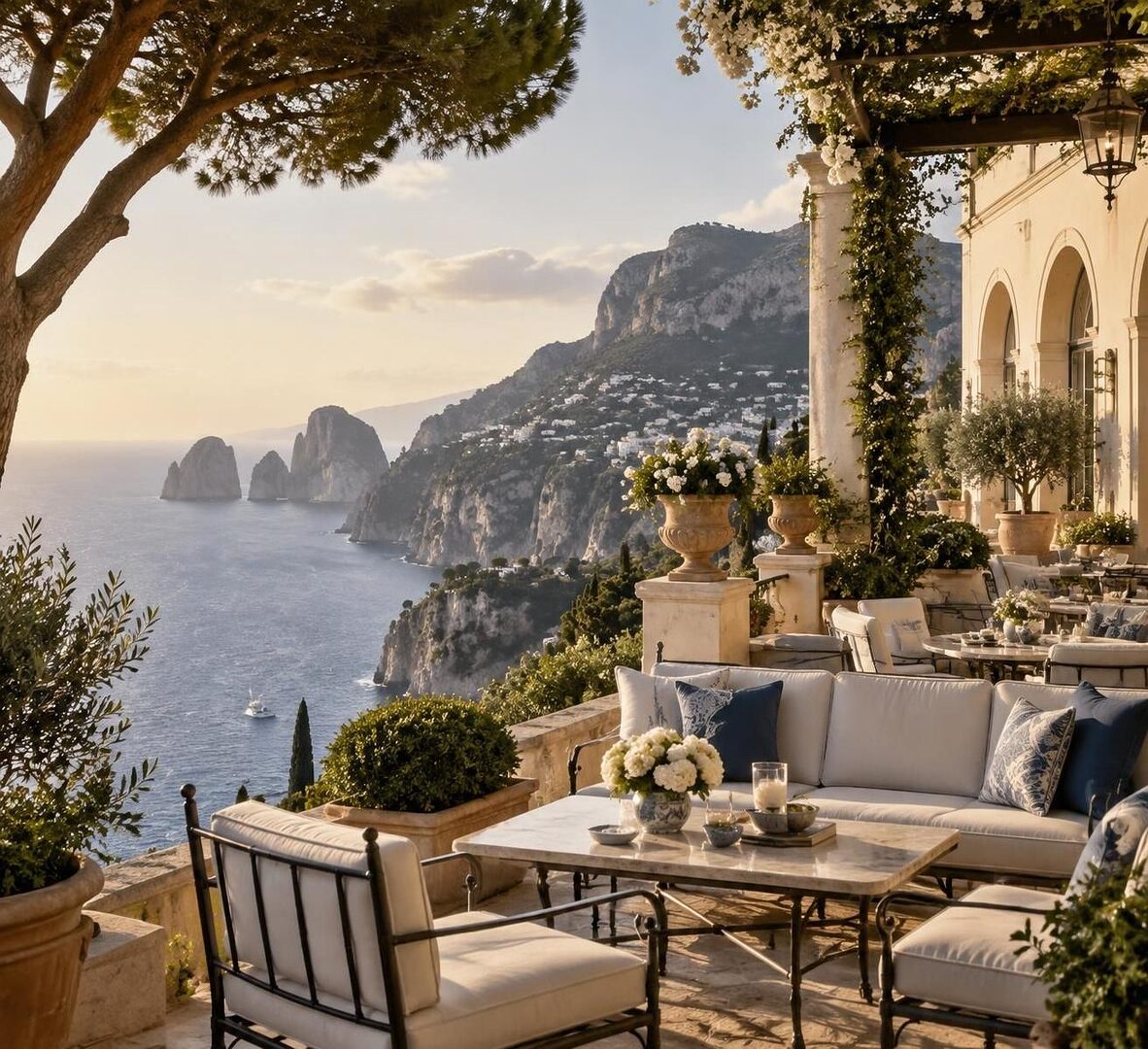
Punta Tragara and La Scalinatella: Sea-View Suites and Coastal Elegance
Capri’s southern side is defined by cliffs, deep-blue water, and the Faraglioni rock formations. Hotels in this part of the island make the scenery a central feature of the stay, and Punta Tragara and La Scalinatella are two distinctive choices for travelers drawn to that setting. Their appeal is not only a striking outlook; it is the feeling of being slightly removed from the busiest streets while remaining within reach of Capri town.
Punta Tragara occupies a memorable position above the coastline, where the landscape becomes part of the property’s character. It is a strong option for guests who want Mediterranean views and a sense of seclusion without choosing a completely remote base. The setting is particularly appealing to travelers who plan to spend time at the hotel between excursions. Those who prefer to be close to shops and restaurants should still consider walking distances and the local terrain, rather than relying on a map’s straight-line measurements.
La Scalinatella offers a more intimate atmosphere than a large resort, with a style often associated with the island’s traditional hospitality. Its location and design can appeal to guests who value quiet corners, attentive service, and a relaxed pace. Boutique hotels such as this may feel more personal, but their room inventory and facilities can differ from those of larger properties. Travelers should confirm which amenities matter most to them—such as a pool, a particular room configuration, or on-site dining—before making a decision.
How to assess a sea-facing room
Not every room with a coastal outlook delivers the same experience. A terrace, balcony, floor level, and angle of view can all affect how much of the scenery is visible from the room itself. A traveler who expects to enjoy long mornings outdoors may find a private terrace worth prioritizing, while someone who spends most of the day exploring may prefer to invest in location or service instead. Clear descriptions and current room photographs are more useful than relying on a broad label such as “sea view.”
It is also worth considering sun exposure and privacy. A west-facing terrace may be especially attractive late in the day, while another orientation may provide more shade during warmer hours. Views can sometimes include neighboring buildings or shared outdoor areas, so guests who value privacy should ask specific questions rather than assuming that a dramatic setting guarantees seclusion.
These cliffside properties illustrate why a hotel comparison should account for more than star ratings. A traveler seeking coastal elegance may value a quiet terrace and a direct visual connection to the Faraglioni more than a central address. Another may prefer to trade some scenery for easier evening access to town. The right room and location make the landscape feel like a genuine part of the stay, not simply a backdrop seen once at check-in.
Historic Charm, Boutique Hotels, and the Case for Private Villas
Capri’s luxury accommodation is not limited to large hotels. Smaller properties and private villas can offer a different balance of privacy, design, and service, making them worth considering for longer stays, family trips, or small groups traveling together. The choice depends on how much structure guests want. A full-service hotel provides an established hospitality framework; a villa can create more room for an independent schedule, though it may require more planning around meals, housekeeping, and transport.
Historic charm is a meaningful part of Capri’s appeal, but it should be evaluated alongside comfort and practical needs. Older buildings can have distinctive architecture, layered interiors, and a strong sense of place. They can also have layouts that differ from newer hotels, including stairs, compact rooms, or less standardized configurations. Travelers with mobility concerns or bulky luggage should check access details in advance. A hotel’s character is most enjoyable when its physical setup fits the guests staying there.
Boutique hotels can offer a more intimate scale and a recognizable design point of view. For example, a couple celebrating an anniversary may prefer a quiet property where the service feels personal and the public areas are not expansive. A family with children, however, might place more value on connecting rooms, a pool, flexible dining, and straightforward transport. “Boutique” describes an atmosphere and scale, not a guarantee of specific amenities, so the details still matter.
When a villa makes sense
Private villas can be attractive when privacy and shared living space are priorities. A family group may appreciate having separate bedrooms, a living area, and an outdoor space where everyone can gather without booking multiple hotel rooms. The comparison should include the full operating arrangement: whether staff, cleaning, breakfast, or transport coordination is provided, and how assistance is accessed if plans change. These elements vary by property and booking terms, so they should be confirmed before committing.
A villa is not automatically less expensive than a hotel. The total cost depends on the number of guests, length of stay, included services, and the season. A group that uses the shared space may find the arrangement worthwhile, while a couple on a short visit could find a hotel more convenient. It is useful to compare the full cost per traveler and the services each option includes, rather than comparing only the nightly headline rate.
Travelers should also consider how much time they intend to spend at the accommodation. Guests who plan to be out from morning until evening may not benefit from a large private residence. Those who want long lunches, quiet afternoons, or family time may appreciate the added room. Across Capri, the best match is the one whose scale and service align with the way the trip will actually unfold.
How to Compare Capri Luxury Hotels Before Booking
A smart hotel decision begins with an itinerary, not a star rating. List the experiences that matter most—time in Capri town, boat excursions, quiet afternoons, hiking, or dining—and then map each hotel’s location against those plans. Capri’s compact size can be misleading: steep lanes, busy transport periods, and the island’s divided centers mean a short distance on a map does not always equal a simple journey. A hotel’s transfer guidance and walking access are practical parts of its value.
Next, compare room categories carefully. A higher room type may include a terrace, a more open view, or additional space, but the wording varies from one property to another. Ask for clarification when a specific feature is central to the decision. For example, a traveler who hopes to watch the sunset from a private balcony should confirm that the booked category actually includes an outdoor space with the desired orientation.
Priority | Hotel style to compare | Question to ask |
|---|---|---|
Easy access to shops and dining | Central Capri town hotels | How close is the property to the areas planned for evening visits? |
Quiet setting and broad scenery | Anacapri or cliffside retreats | What transfer options are available, and how often will transport be needed? |
Privacy and shared space | Private villas or intimate boutique hotels | Which services, staffing, and housekeeping are included? |
A distinctive room outlook | Sea-view suites and terrace rooms | Is the view full or partial, and is a private terrace included? |
Seasonality deserves attention as well. Many island hotels operate on seasonal schedules, and the range of services may change over the course of the year. Confirm opening dates, restaurant availability, pool operation, and cancellation conditions for the actual travel dates. A rate that appears attractive may not represent the same package as a competing offer, so compare inclusions and terms rather than relying on price alone.
Finally, consider what “luxury” means to the people traveling. For one guest, it may mean a sea-view suite and attentive Italian hospitality; for another, it may mean a central location that saves time or a private villa that lets a family share meals. A simple decision list can help: identify the two features that matter most, the one compromise that is acceptable, and any access or service requirements that are non-negotiable. That approach makes the hotel search more focused and reduces the chance of paying for features that will go unused.
Questions Travelers Often Ask About Hotels in Capri
Which part of Capri is best for a first stay?
Capri town suits travelers who want shops, restaurants, and the Piazzetta close by. Anacapri and cliffside locations can offer a quieter atmosphere, but transport planning becomes more important.
Are sea-view rooms worth the higher rate?
They can be worthwhile for travelers who expect to spend time on a terrace or in the room enjoying the scenery. Confirm whether the view is full or partial and whether a private balcony or terrace is included.
Are private villas a better choice than hotels?
Villas can suit families or groups who value privacy and shared space. Hotels may be more convenient for guests who want on-site services, dining, and a staffed reception; compare total costs and included services.
What should guests confirm before booking a Capri hotel?
Check seasonal opening dates, room orientation, transfer arrangements, accessibility, cancellation terms, and which services are included in the quoted rate.

At 33 years old, I specialize as a Licensed Residential Real Estate Advisor and Property Market Analyst. With a deep understanding of market trends and client needs, I provide strategic insights and personalized guidance to help clients make informed real estate decisions.