Luxury epoxy floor coatings stand apart from standard options because they are designed as complete flooring systems, not simply as a layer of paint. Their richer materials, carefully prepared concrete, decorative techniques, and protective topcoats can create a distinctive finish while helping the surface withstand everyday use. The difference is visible in a basement, garage, showroom, or salon—but it also lies beneath the gloss, where adhesion, moisture control, and installation quality determine whether the floor continues to perform.
The label “luxury” is not a standardized product grade, so buyers should look beyond marketing language. A metallic finish may deliver dramatic movement, while decorative flakes or quartz can provide a more textured appearance. In each case, the practical questions are similar: what layers are included, how will the slab be prepared, what topcoat protects the surface, and does the design suit the way the room is used?
At a glance
- Luxury epoxy is a multi-layer system with decorative and protective components; basic garage coatings may be thinner and simpler.
- Metallic effects, flakes, and quartz create different looks and levels of texture, so finish choice should reflect both style and function.
- Surface preparation and moisture testing are central to adhesion and long-term performance.
- Installed costs vary with the coating system, slab condition, design, location, and labor.
- Epoxy works especially well in garages, basements, workshops, and commercial spaces, though its hardness and temperature can be less comfortable in some living areas.
How Luxury Epoxy Floor Coatings Differ From Standard Options
The main distinction between luxury epoxy and a basic floor coating is the complete system. A standard do-it-yourself product may be designed to refresh a garage slab with a relatively simple application. Premium installations typically involve several coordinated layers: a primer, a colored or pigmented base, decorative material where desired, and one or more clear protective coats. The exact products and thickness depend on the manufacturer’s system and the condition of the concrete.
Some higher-build systems use 100 percent solids epoxy, meaning the product does not rely on water or solvent carriers that evaporate as it cures. Installers may describe coating thickness in mils, with one mil equal to one-thousandth of an inch. A stated system thickness alone, however, does not prove quality; the product specifications, preparation method, and installer’s workmanship matter just as much.
Think of the layers as parts of a building envelope. The primer helps bond the system to properly prepared concrete, the decorative layer supplies color or pattern, and the topcoat takes the direct wear from foot traffic, tires, spills, and cleaning. A weak or incompatible layer can undermine the rest, much as a premium finish cannot compensate for a poorly prepared wall.
Standard products may have a lower upfront price and can be reasonable for a lightly used space where expectations are modest. Luxury systems are generally selected when owners want a more tailored appearance, added protection, or both. Neither category should be assumed to last for a specific number of years without considering traffic, sunlight, moisture, maintenance, and installation conditions.
Reading product claims and installed prices
Published estimates for professionally installed decorative systems commonly span several dollars to more than twenty dollars per square foot. As a broad planning reference, some market guides place simpler solid-color systems around $6 to $10 per square foot, flake systems around $7 to $14, quartz systems around $9 to $16, and metallic designs around $12 to $20. Image-based 3D floors can cost more, with estimates sometimes ranging from $20 to $40 per square foot.
These are not fixed national rates or guaranteed quotes. A contractor may charge more when the slab needs crack repair, grinding, moisture mitigation, or extensive edge work. A 500-square-foot floor also does not necessarily cost exactly five times the price of a 100-square-foot job, since mobilization, equipment, and minimum labor charges can affect small projects.
For a useful comparison, request an itemized scope that identifies each coat, the product manufacturer, the surface-preparation method, and any warranty terms. A low bid that omits preparation or the protective topcoat may not be comparable to a complete installation. The meaningful comparison is between complete systems, not between the word “epoxy” on two estimates.
Premium Finishes, Metallic Effects, and Custom Designs
Luxury epoxy offers a broader visual range than a plain gray or tan coating. Four common finish families are metallic pigments, decorative flakes, colored quartz aggregate, and solid-color systems protected by clear coats. A separate option uses a printed image beneath transparent resin. Each creates a different balance of visual impact, texture, maintenance, and price.
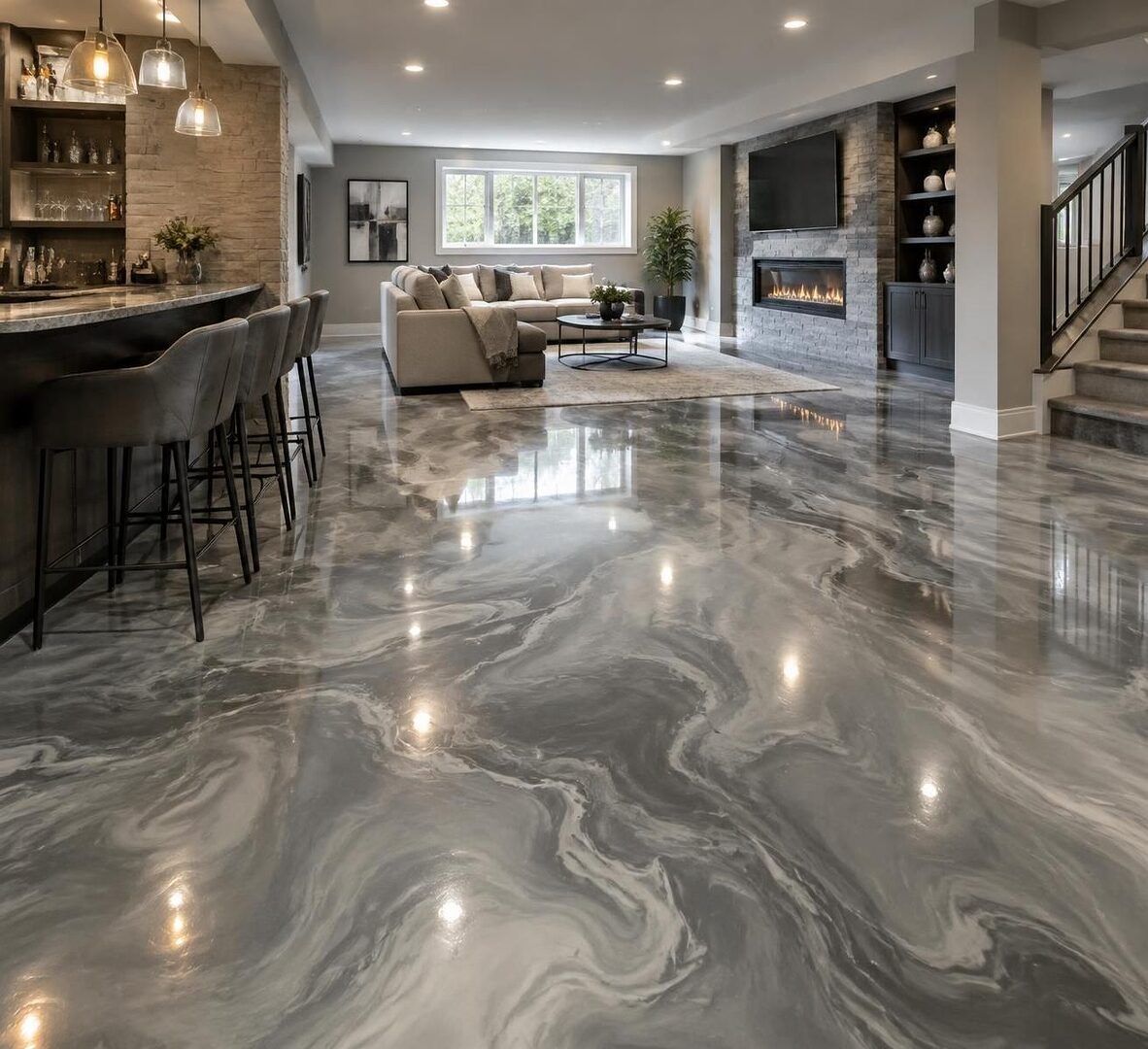
Metallic epoxy uses reflective pigments suspended in resin to create depth and flowing patterns. While the coating remains workable, an installer moves the material with tools or airflow to shape the design. The result can resemble polished stone, clouds, or rippling water, but the pattern is created by hand and will vary from one floor to another. A sample board can help establish the intended palette, though it cannot reproduce every detail of a full installation.
Color influences how the floor feels and how it relates to the room. Silver and gray often complement contemporary interiors; bronze, gold, and copper can add warmth; blue and green can create cooler, more dramatic effects. Pearlescent white may brighten a small room, while a dark base with contrasting flakes can give a garage or entertainment space a starry appearance. Lighting and nearby finishes change how these colors read, so samples should be viewed under the room’s actual lighting when possible.
Decorative flake systems broadcast colored chips across a wet base coat and seal them under clear layers. The chips can soften the appearance of minor dust and provide visual texture. Depending on the system and topcoat, they may also contribute to traction, but a flake floor should not automatically be described as slip-proof. The installer can adjust flake coverage and topcoat texture to suit the setting.
Quartz aggregate incorporates colored grains into the finish, producing a more pronounced texture that is often considered for busy commercial or service areas. It can be a practical choice where a decorative surface needs more grip than a smooth metallic floor. A solid-color system, by comparison, delivers a restrained appearance and can work well where clean lines matter more than a complex pattern.
Matching the finish to the property
Consider the room’s purpose before choosing a dramatic design. A boutique showroom may benefit from metallic effects and a high-gloss sheen that reflects display lighting. A workshop may be better served by flakes or quartz, where visual character and surface texture can coexist. In a basement, a custom design can help the floor feel intentional rather than like an unfinished slab.
Also consider how permanent the visual choice will feel. A highly distinctive floor can strengthen a design concept, but it may narrow the range of furniture and décor that work comfortably with it. Neutral tones tend to offer more flexibility, while a bold multi-color blend can become the dominant feature of the room.
In real estate terms, visual appeal is most useful when it supports the property’s function and overall finish level. A polished garage can complement a carefully maintained home, but a striking floor will not replace sound concrete or solve other property issues. The strongest design is one that looks considered and works for the people using the space.
Seeing a finished floor can clarify the design possibilities, but installation footage should not be treated as a substitute for product specifications or a written scope. The next question is whether the desired look suits the room’s daily demands.
Durability, Stain Resistance, and the Best Rooms for Epoxy
A properly selected and installed epoxy system can provide durability, stain resistance, and chemical resistance for many residential and commercial uses. Its seamless surfaces limit the joints where dust and debris can collect, and the clear topcoat helps shield the decorative layer from routine wear. These properties can make epoxy easier to clean than porous concrete or flooring with many seams, though no coating is immune to damage.
Performance depends on the whole assembly. A clear coat may improve resistance to abrasion or household spills, but exposure to strong chemicals, standing liquids, hot tires, dragged equipment, or sharp impacts can still affect the finish. Product labels specify compatibility and limitations, and those details should guide the choice for a particular use. A floor intended for occasional household parking may not meet the needs of a repair shop.
Garages, workshops, home gyms, utility rooms, and commercial showrooms are common applications because they benefit from a hard-wearing surface that is relatively simple to sweep and mop. Salons, retail spaces, hotel lobbies, and restaurants may use decorative resin systems to coordinate flooring with a broader interior design. In a showroom, a glossy surface can support enhanced aesthetics by reflecting light around vehicles or products; in a workshop, a more textured finish may be more practical.
Basements are another frequent candidate. A coated slab can be easier to clean after ordinary spills and may be less vulnerable to surface staining than unfinished concrete. However, epoxy is not a waterproofing solution for a basement with active water intrusion. Drainage problems, foundation leaks, or persistent slab moisture need to be addressed before a coating is considered, or the flooring system may fail.
Comfort, sunlight, and slip considerations
Epoxy is hard underfoot, which can be tiring for someone who stands for long periods. It can also feel cold in winter because it is installed over concrete. Those traits may be acceptable in a garage or utility area but less appealing in a bedroom or living room where softness and warmth are priorities. Area rugs or anti-fatigue mats may improve comfort in selected work zones, provided they are suitable for the floor and do not trap moisture.
Sun exposure deserves attention as well. Some epoxy formulations can discolor or amber under ultraviolet light. A UV-stable polyaspartic or polyurethane topcoat may help protect the appearance, but its suitability depends on the complete coating system and the exposure conditions. Ask the installer what protection is specified for sunlit spaces rather than assuming that every clear coat offers the same resistance.
Gloss is not the same as traction. A smooth, high-gloss surface can be slippery when wet, particularly if water, oil, or cleaning residue is present. Texture additives or suitable aggregate may improve grip, although they can make cleaning more involved. Choosing a floor means balancing appearance with the conditions under which people will walk, work, and move equipment.
Surface Preparation and Professional Installation Quality
Surface preparation is often the least visible part of a finished floor and one of the most important. Concrete must be sound, clean, and properly profiled so the coating can bond. Oil, dust, sealers, curing compounds, and weak surface material can interfere with adhesion. Cracks and damaged areas also need to be assessed and repaired using materials compatible with the coating system.
Professional installers commonly use mechanical preparation such as diamond grinding or shot blasting to create the surface profile required by the product manufacturer. The appropriate method depends on the slab and the specified coating. Acid etching, sometimes included with basic do-it-yourself products, does not necessarily provide the same profile or consistency required for a high-build decorative installation.
Moisture testing is another essential step. Concrete can transmit moisture vapor from below, even when the surface appears dry. Installers may use methods such as in-situ relative humidity probes or calcium chloride testing, following the applicable method and the coating manufacturer’s limits. If moisture readings exceed the system’s allowance, a compatible mitigation primer may be needed; otherwise, bubbling, cloudy appearance, or loss of adhesion can occur.
That risk matters to a property owner because a floor failure can require grinding away the coating before a new system is installed. For example, a homeowner converting a basement into a workout room might be attracted to a metallic finish, but skipping moisture evaluation could make the visual investment short-lived. Identifying a moisture concern before installation gives the owner a chance to compare remediation options and revise the project scope.
Why installation timing and workmanship matter
Decorative resins have limited working times once mixed. The installer must coordinate mixing, pouring, pattern work, and transitions while the material remains workable. Metallic patterns require judgment about pigment placement and movement; a rushed pour can create an unintended appearance or visible inconsistencies. Temperature, humidity, ventilation, and the concrete’s condition can also affect curing and application.
Installation credentials and licensing requirements vary by state and locality, and some places do not require a specific trade license for this work. That makes documentation and references especially useful. Ask to see completed projects that have been in service for at least a year or two, and, where practical, inspect one in person. A newly finished floor shows color and gloss; an older installation offers a better view of how the system has held up.
Request the product names for the primer, base coat, decorative layer, and topcoat. Established manufacturers offer technical data sheets that explain intended uses, application conditions, and limitations. A qualified installer should be able to explain why the proposed products suit the slab and the room rather than relying on a vague assurance that the system is “commercial grade.”
Finally, confirm what the written warranty covers and excludes. Ask whether it addresses adhesion, discoloration, or workmanship, and whether maintenance or use conditions affect coverage. Careful preparation and a clearly documented installation plan are more reliable indicators of long-lasting performance than a glossy sample alone.
Cost, Maintenance, and Choosing a Qualified Installer
The installed price of luxury epoxy reflects more than the resin itself. Labor, concrete preparation, repairs, moisture mitigation, decorative complexity, square footage, access, and local market conditions all influence the estimate. Metallic designs usually require more hands-on artistic work than a straightforward solid-color coating, while a flake system’s cost can vary with the materials and level of coverage.
Compare at least two or three detailed proposals when feasible. Each should state the preparation method, planned repairs, primer and coating products, number of coats, decorative options, cure time, and conditions for warranty coverage. Ask whether the price includes moving stored items, masking adjacent surfaces, and returning to apply later coats. These details prevent a lower initial bid from concealing work that will be billed separately.
Do-it-yourself kits can suit homeowners who want a basic refresh and understand the limits of the product. A luxury metallic installation is a different undertaking: it requires mechanical preparation, coordinated mixing, rapid application, and control of the decorative pattern. Renting specialized equipment and correcting an unsuccessful application can reduce or eliminate any expected savings. For a high-visibility room or an expensive slab, professional installation may be the more predictable route.
Keeping the finish in good condition
Routine care is usually straightforward. Sweep or dust-mop to remove grit that could scratch the surface, then damp-mop with a cleaner approved for the coating. Avoid assuming that a product safe for tile or wood is suitable for epoxy; harsh acids, abrasive pads, or incompatible solvents may dull or damage the finish. Follow the installer’s maintenance instructions and the coating manufacturer’s guidance.
Small scratches may be treatable with a compatible polishing product, while deeper damage can require a resin repair. A patch is often easier to blend when the owner has retained the product details and a sample of the original color blend. Before work begins, ask whether the installer can provide a labeled sample or record the exact materials used.
Topcoat renewal is sometimes recommended after years of use, particularly where the floor receives sunlight, heavy traffic, or frequent cleaning. Published planning estimates for a recoat may fall around $2 to $4 per square foot, but actual costs depend on the amount of preparation and the products selected. A recoat refreshes the protective surface; it does not correct moisture problems or poor adhesion below it.
Assess the long-term value in relation to how the room is used. A garage that sees daily vehicles and occasional spills may justify a more robust decorative system than a storage room used a few times each year. Conversely, an expensive metallic finish is not automatically a better choice if the space needs warmth, softness, or a less reflective surface. The right investment is the system whose appearance, maintenance, and performance match the property’s real demands.
Frequently Asked Questions About Luxury Epoxy Flooring
What makes luxury epoxy flooring different from standard garage coating?
Luxury systems generally combine concrete preparation with multiple coating layers, decorative finishes, and protective topcoats. Standard products may be simpler and thinner; compare the specified materials and scope rather than relying on the label alone.
Are metallic epoxy floors suitable for homes?
Yes. They are used in areas such as garages, basements, kitchens, and selected living spaces. Their hard, cool surface and possible slipperiness when wet may make them less comfortable in rooms where softness and warmth are priorities.
How much does luxury epoxy flooring cost?
Pricing varies with location, slab condition, preparation, finish, and labor. Broad published estimates range from about $6 per square foot for simpler systems to $20 or more for elaborate metallic designs, with image-based finishes potentially costing more. Obtain a detailed local proposal.
Can luxury epoxy be installed over a damp basement slab?
Moisture should be tested before installation. If readings exceed the coating system’s limits, a compatible moisture-mitigation approach may be required. Epoxy should not be treated as a remedy for active water intrusion or unresolved drainage problems.
Is metallic epoxy flooring a good DIY project?
It is generally more demanding than applying a basic garage coating because preparation, mixing, timing, and hand-shaped pigment patterns require experience. For a complex decorative finish, a qualified installer can reduce the risk of visible defects or adhesion problems.

At 33 years old, I specialize as a Licensed Residential Real Estate Advisor and Property Market Analyst. With a deep understanding of market trends and client needs, I provide strategic insights and personalized guidance to help clients make informed real estate decisions.