
A villa and a mansion can both offer generous space, elegant finishes, and a premium residential experience, but the labels describe different ideas. A mansion is generally defined by its scale and grandeur, while a villa is more closely associated with privacy, a setting that connects to the outdoors, and a particular style of relaxed living. Neither term has one universal legal definition in the United States, so a property’s marketing description may not match a buyer’s assumptions.
For a useful real estate comparison, look beyond the name on a listing. Consider the property size, location, architectural style, grounds, maintenance needs, and the way the home will be used. A 6,000-square-foot suburban residence might be marketed as a mansion, while a smaller coastal home with a courtyard and pool may be called a villa—even though both could be expensive luxury homes.
In brief:
- Mansion usually emphasizes a large, imposing home with substantial interior space and high-end features.
- Villa traditionally suggests a private residence designed around leisure, outdoor living, and its surroundings.
- There is no nationwide square-footage threshold that officially separates the two property types.
- Location, design, upkeep, and intended use can matter more than the label.
- Before buying, compare comparable sales, operating costs, property condition, and local land-use requirements.
Villa vs. Mansion: What Each Property Type Means
In everyday U.S. real estate language, “mansion” describes a notably large and impressive private home. Buyers often associate the term with multiple bedrooms, formal entertaining rooms, expansive floor plans, and substantial finishes. However, there is no single national rule that makes a home a mansion once it passes a particular square-footage mark; the word is descriptive, and its meaning can shift with local expectations and marketing.
“Villa” has a different history and emphasis. The word traces back to Roman country residences, which could combine a substantial home with grounds and agricultural buildings. In modern usage, it often refers to a detached or semi-detached home with a private, resort-like feel, frequently featuring a garden, terrace, courtyard, or pool. In some parts of the United States, “villa” is also used for smaller suburban homes or homes in planned communities, so the listing context matters.
These definitions overlap. A large Mediterranean-inspired home with a pool and formal gardens could reasonably be described as both a villa and a mansion, depending on its scale and setting. The labels are best treated as clues about character and lifestyle, not as verified measures of size, quality, or value.
Why listing terminology can vary
Real estate descriptions are shaped by regional convention and the features a seller wants to highlight. A development may call attached, low-maintenance homes “villas,” while a luxury listing may use “mansion” to convey scale and prestige. Buyers should confirm what the home actually includes through the listing details, disclosures, plans, and an in-person or virtual tour.
Imagine a buyer named Morgan comparing two homes. One is a 4,200-square-foot house on a wooded lot marketed as a villa; the other is a 5,800-square-foot urban residence called a mansion. The names communicate different impressions, but Morgan still needs to assess condition, usable space, privacy, and ongoing costs to determine which property fits.
The practical distinction is one of emphasis: a mansion points first to grandeur, while a villa points more often to setting and a leisure-oriented way of living.
Property Size, Location, and Outdoor Space
Size is often the most visible difference in a villa vs. mansion comparison, but it is not a reliable standalone test. Mansions are commonly understood to be large homes, sometimes with numerous bedrooms, several living areas, and multiple floors. A figure such as 5,000 square feet is sometimes used informally to describe a mansion, but it is not a universal cutoff or an official classification.
Villas can range from compact retreats to substantial estates. Their defining quality is often the relationship between the home and its surroundings: a shaded patio, private garden, view corridor, or direct access to outdoor recreation. A well-designed 3,000-square-foot villa may feel more connected to its landscape than a much larger home whose main spaces face inward.
Location also shapes the distinction. Villas are traditionally associated with countryside, coastal, or scenic settings, though contemporary examples appear in suburbs and resort communities. Mansions can be found in affluent urban neighborhoods, suburbs, or on rural acreage; the term does not require a city address or a particular lot size.
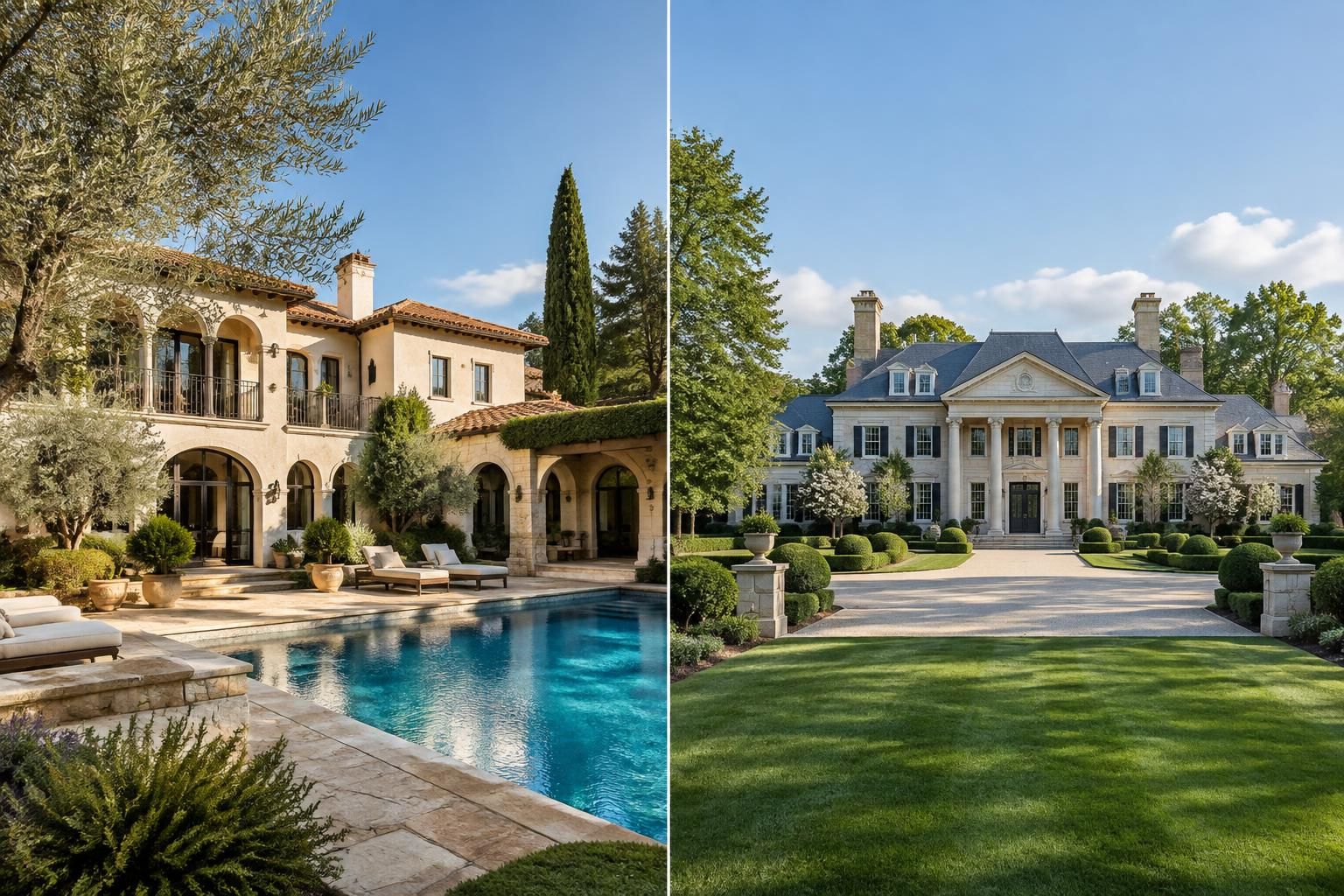
How the site changes the experience
Outdoor space is not simply a matter of acreage. A villa’s courtyard may provide privacy on a modest lot, while a mansion’s large lawn can create distance from neighbors but add landscaping and irrigation responsibilities. Local climate, drainage, slope, tree cover, and access to outdoor amenities affect how usable the grounds are throughout the year.
For instance, a family choosing between a coastal villa and a suburban mansion might value different things. The villa may make it easy to move between indoor rooms and a covered terrace, while the mansion may provide separate spaces for guests, work, hobbies, and large gatherings. Neither option is inherently more functional; the right fit depends on daily routines and the upkeep the household is prepared to handle.
When evaluating property size, distinguish finished living area from garages, unfinished basements, accessory buildings, and outdoor structures. Listing conventions and measurement methods can vary, so review the property’s records and ask how reported square footage was calculated.
Square footage describes scale, but the site plan reveals how a home actually lives.
Architectural Style and Residential Architecture
Villas are often associated with Mediterranean or classical influences, including stucco exteriors, tile roofs, shaded loggias, courtyards, and a strong connection to gardens. Those features are common references, not requirements. A modern villa might use clean lines, large windows, and restrained materials while retaining the same emphasis on privacy and outdoor living.
Mansions have no single architectural style. They may be Georgian, Victorian, Beaux-Arts, Colonial Revival, contemporary, or a blend of influences. Their identity tends to come from scale, formal composition, and prominent home features such as a grand entry, broad staircase, tall ceilings, or large entertaining rooms. Some are historic properties; many are newer construction.
Architectural style affects more than appearance. The orientation of windows, roof design, exterior materials, and relationship between rooms can influence natural light, privacy, heating and cooling needs, and future maintenance. A stone façade, for example, may require different care from wood siding, while a complex roofline can be more difficult to inspect and maintain than a simple design.
Historical character versus contemporary design
Some historic mansions carry distinctive craftsmanship and a strong sense of permanence, but age alone does not confirm quality or condition. Buyers should pay attention to the inspection findings, system updates, and any restrictions that may apply to a historic property. Local preservation rules differ, so questions about exterior changes or renovation approvals should be directed to the relevant local authority.
Villas can also be historic, but contemporary versions often adapt traditional ideas to present-day living. An open kitchen facing a courtyard, for example, can preserve a private, retreat-like atmosphere without copying a historical floor plan. This flexibility is one reason the villa label appears across a wider range of residential architecture.
Consider a buyer who likes the look of a historic mansion but wants a low-maintenance exterior. A recently built home with classical proportions may offer a similar visual effect with newer systems, while a renovated older property may provide original details that cannot easily be replicated. Each presents different trade-offs in character, maintenance, and renovation potential.
Style describes the home’s visual language; design and condition determine how well it serves its occupants.
Home Features, Amenities, and Everyday Lifestyle
Mansions often have more rooms and a broader range of amenities, particularly when designed for entertaining or accommodating a large household. Features may include a theater, wine room, indoor pool, gym, guest suite, or multiple formal living areas. These are possibilities, not defining requirements: a large home can still have a simple amenity package, and a smaller residence can include high-end facilities.
Villas more often foreground personal leisure and indoor-outdoor living. A private pool, garden, outdoor kitchen, fireplace, or covered dining area may be central to the design. The aim is not necessarily to maximize the number of features but to make relaxation and access to the outdoors feel natural.
More amenities bring additional costs and responsibilities. Pools need ongoing care, specialized equipment may require service, and extensive grounds can call for regular landscaping. In a mansion, unused rooms can also add to heating, cooling, cleaning, and furnishing expenses. Buyers should distinguish features they will use from features that are impressive during a tour but costly to maintain.
Match the home to how it will be used
A household that regularly hosts extended family may benefit from a mansion’s separate guest areas and multiple gathering spaces. A couple seeking a quiet second home may prefer a villa with a manageable floor plan, private outdoor space, and easy access to local attractions. These examples illustrate a broader point: a home’s functional layout can matter more than its status label.
Before deciding, buyers can make a short list of practical priorities:
- Daily use: Which rooms and amenities will support ordinary routines?
- Privacy: Does the layout or landscaping provide the level of separation desired?
- Maintenance: What regular care will pools, grounds, specialty systems, and finishes require?
- Accessibility: Are stairs, long corridors, and outdoor paths suitable for household members and visitors?
- Flexibility: Can rooms adapt to changing needs, such as remote work or guests?
Neighborhood context matters as well. A home theater or large event space may be useful to one owner and unnecessary to another, while neighborhood rules, insurance conditions, or local requirements can affect how certain amenities are used. Those details should be checked for the specific property rather than assumed from its category.
The most valuable amenities are the ones that support real routines, not simply the ones that lengthen a listing description.
Cost, Ownership, and a Practical Villa vs. Mansion Comparison
There is no dependable price range that separates villas from mansions. Purchase price is influenced by location, land, condition, construction quality, design, and comparable recent sales. A modestly sized villa in a high-demand coastal market may cost more than a much larger home in a less expensive area, while a mansion with extensive grounds and custom features may carry substantial ownership expenses.
Beyond the purchase price, compare the full cost of owning the property. Property taxes, homeowners insurance, utilities, repairs, landscaping, and any HOA dues can vary significantly by location and property. Large or older homes may have more systems and surfaces to maintain, while a villa with a pool or extensive outdoor kitchen can also require specialized care.
For a grounded real estate comparison, review recent comparable sales—often called “comps”—and consider how closely each sale matches the property in location, size, condition, lot, and features. A real estate professional can help interpret local market evidence, but buyers should also review property disclosures and inspection results. An appraisal, when part of a financed purchase, is a separate valuation process and does not replace a thorough condition assessment.
| Factor | Villa | Mansion |
|---|---|---|
| Typical emphasis | Privacy, setting, and outdoor living | Scale, formality, and impressive interior space |
| Property size | Varies widely; often more compact than a mansion | Usually large, but no universal size threshold applies |
| Architectural style | May reference Mediterranean, classical, or modern designs | Can span historic, traditional, contemporary, or mixed styles |
| Common home features | Courtyard, garden, terrace, or private pool | Multiple living areas and a wider range of luxury amenities |
| Ownership considerations | Outdoor features and location may drive upkeep | Interior scale, grounds, and specialized systems may add costs |
Questions to ask before making an offer
Buyers should establish whether the home’s layout supports their needs, then investigate the condition of major systems and the maintenance history of distinctive features. It is also useful to ask whether the property has an HOA, what services or restrictions apply, and whether planned uses are consistent with local rules. Requirements vary by jurisdiction and community, so verify details with the appropriate local sources.
A fictional buyer, Morgan, might narrow the choice by estimating annual upkeep rather than focusing only on list price. If Morgan plans to use a second home seasonally, a large property with staff-dependent grounds could be less practical than a smaller retreat; if frequent multigenerational gatherings are central, the extra rooms in a mansion may justify the added work. The comparison becomes clearer when ownership is considered as a long-term commitment rather than a label.
Compare the specific homes, their local market evidence, and their ongoing obligations; “villa” and “mansion” alone cannot establish value.
Common Questions About Villas and Mansions
Is a mansion defined by a minimum square footage?
No nationwide standard sets a required square footage for a mansion. The term is generally descriptive and refers to a notably large, impressive home; local usage and listing language can vary.
Can a villa be larger than a mansion?
Yes. Villa and mansion are not formal size classifications, so a large villa can exceed the size of a home marketed as a mansion. The terms emphasize different qualities, and property details should be verified independently.
Are villas always located in the countryside?
No. Villas are traditionally associated with country or coastal settings, but modern homes and planned communities use the term in suburban and resort locations as well.
Which property type costs more to maintain?
Costs depend on the individual home, location, condition, and amenities. A mansion’s size may increase utility and repair expenses, while a villa with a pool, extensive gardens, or specialty features can also require significant upkeep.

At 33 years old, I specialize as a Licensed Residential Real Estate Advisor and Property Market Analyst. With a deep understanding of market trends and client needs, I provide strategic insights and personalized guidance to help clients make informed real estate decisions.