
Delivery routes influence far more than the time a driver spends on the road. They shape fuel use, labor costs, customer communication, vehicle capacity, and the reliability of the wider supply chain. For businesses coordinating many stops across multiple vehicles, route optimization turns those competing demands into a workable plan: which orders go on each vehicle, who delivers them, and in what sequence.
Effective logistics planning is not simply a matter of finding the shortest line between addresses. A route that saves miles but misses a customer’s delivery window, exceeds vehicle capacity, or leaves a driver short on time is not efficient in practice. Strong planning combines accurate order and location data with operating rules, while giving dispatchers a way to respond when traffic, customer availability, or vehicle conditions change.
In brief
- Route optimization coordinates stop sequence, vehicle assignment, delivery windows, capacity, and driver availability.
- Realistic service times and accurate addresses are as important as routing software.
- Dynamic updates can help teams respond to disruptions, but changes should be controlled and communicated clearly.
- Businesses should measure cost, delivery performance, fleet use, and customer outcomes against a baseline.
- A pilot and frontline feedback can reveal whether a route plan works outside the planning screen.
How Route Optimization Improves Logistics and Delivery Efficiency
Route optimization is the process of organizing deliveries across a fleet to meet business and customer requirements with the least avoidable time, distance, and expense. It commonly involves grouping orders, assigning them to vehicles and drivers, sequencing stops, and estimating when each delivery can be completed. The objective is not always the shortest route; it is a route that performs well against the operation’s actual priorities.
That distinction matters in residential delivery. A van carrying bulky furniture may have room for fewer stops than a parcel vehicle, while a customer in a secured apartment building may require more service time than a customer with a front-door drop-off. A plan based only on miles can overlook both realities. Delivery efficiency depends on matching the route to the work.
Consider a fictional regional home-goods distributor, Cedar & Main, serving a mix of suburban neighborhoods and apartment buildings. Its dispatcher initially assigns stops by looking at a map and dividing the area among drivers. The result seems reasonable until one vehicle carries several oversized orders, a building requires timed dock access, and afternoon congestion delays a sequence of customer appointments. The problem is not a lack of effort; the plan did not account for enough operating constraints.
Software can evaluate these factors together, but it still depends on sound inputs. Useful information includes delivery addresses and geocodes, order dimensions or weight, vehicle capacity, driver shifts, service duration, promised time windows, depot departure times, and road restrictions. If an address is inaccurate or a delivery is routinely estimated at five minutes when it takes twenty, the resulting schedule may be mathematically tidy but operationally unrealistic.
Better routing can support fuel efficiency by reducing unnecessary backtracking and helping consolidate stops. It can also improve fleet management by making vehicle workloads more visible and identifying routes that consistently run too long. Neither outcome is automatic: actual results depend on the starting process, data quality, traffic conditions, service mix, and whether drivers can execute the plan.
For a residential business, this has a familiar parallel: a property schedule must account for access, timing, and the needs of people at each location, not merely the distance between addresses. In logistics, the most useful route is the one that can be completed safely and reliably under real conditions.
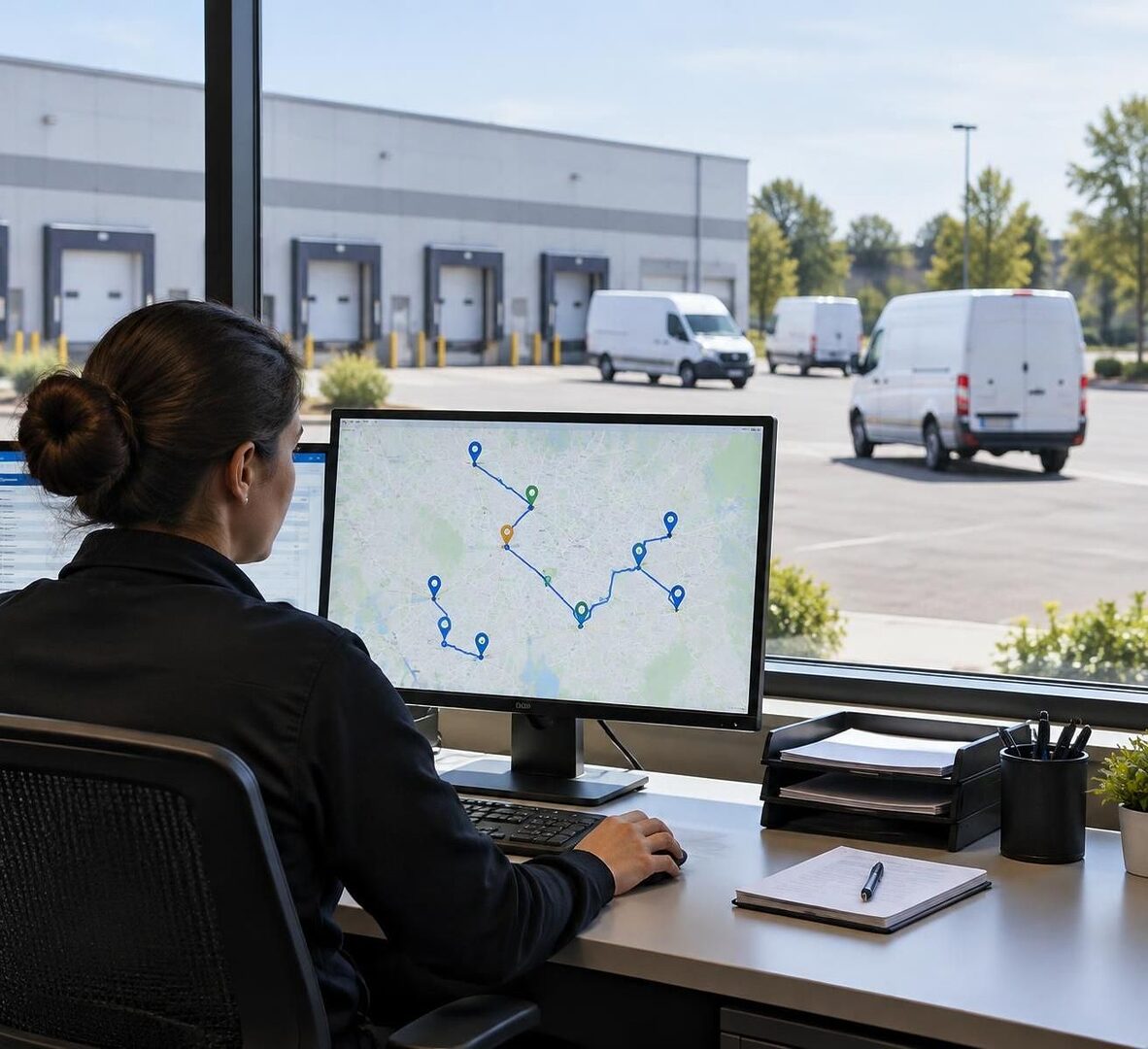
Route Planning Constraints That Make Delivery Routes Work
Route planning begins with a practical question: what must be true for a driver to complete the assigned work? A route may need to respect a customer’s delivery window, the vehicle’s load limits, a driver’s scheduled shift, or a receiving dock’s operating hours. These restrictions narrow the possible choices, so recording them clearly helps prevent plans that look efficient but cannot be carried out.
Time windows are among the most visible constraints. A delivery promised between 10 a.m. and noon cannot simply be placed wherever it fits geographically. The planner must allow enough time to reach the stop, complete the handoff, and travel onward. When many customers have narrow windows, the route may need additional vehicles or a different service promise rather than more aggressive scheduling.
Capacity and vehicle fit also shape assignments. A small van may be suitable for parcels but not for a large appliance order. Capacity may involve package count, weight, volume, refrigeration, or equipment such as a liftgate. Assigning orders based on vehicle type as well as location reduces the chance that a driver reaches a stop with an unsuitable vehicle or an overloaded cargo area.
Service time should reflect the work at the address. A driver might complete a parcel drop quickly, while a bulky delivery may require carrying items inside, customer confirmation, or removal of packaging. Apartment access, parking, gated communities, and loading rules can add time too. For Cedar & Main, tracking actual duration by stop type helps the dispatcher distinguish between a route that is poorly sequenced and one whose service estimates are simply too optimistic.
Other considerations include driver availability, skill requirements, depot cutoffs, road restrictions, and priority orders. In some operations, a driver may need specific training or equipment for particular goods. Local requirements vary, so companies should verify applicable restrictions with relevant authorities and operational partners rather than assuming a routing platform will interpret every rule correctly.
A useful planning checklist includes:
- Location quality: verify addresses, entrances, and map pins, particularly for large residential developments.
- Delivery commitments: distinguish firm appointments from preferred arrival periods.
- Vehicle suitability: match orders to capacity, equipment, and any handling needs.
- Service duration: use observed delivery times and account for access or installation work.
- Workforce limits: schedule within shift availability and the company’s safety and labor procedures.
- Exception rules: define what dispatchers should do when a customer is unavailable or a vehicle is delayed.
These details are not administrative clutter. They determine whether a route can meet its promise, which is why reliable planning begins with an accurate picture of the work.
Static and Dynamic Route Optimization in Transportation
Static route optimization creates a plan from information available before dispatch. It works well when delivery patterns are predictable, such as recurring business-to-business replenishment, scheduled service calls, or fixed neighborhood runs. Planners can prepare routes in advance, communicate assignments, and make loading plans around expected stop sequences.
Its limitation is straightforward: the day rarely follows the plan exactly. A customer may reschedule, a road may close, a vehicle may develop a problem, or a high-priority order may arrive after dispatch. In a stable operation, a dispatcher can handle a small number of changes manually. As the number of vehicles and exceptions grows, keeping every route current becomes harder.
Dynamic routing adjusts some or all of a route as conditions change. Depending on the system and the business rules, it may suggest moving a stop, assigning a new order, or alerting a dispatcher that a promised window is at risk. Real-time tracking can provide visibility into vehicle progress, while traffic or status updates may help teams revise estimated arrival times. The benefit is a faster response; the risk is that frequent changes can confuse drivers or disrupt customer expectations.
For example, Cedar & Main might receive a same-day order while one driver is delayed by a road closure. A dynamic tool could identify a nearby vehicle with appropriate capacity, but the dispatcher still needs to consider whether adding the stop would jeopardize an existing appointment. A useful system presents options and trade-offs, rather than treating every new order as an automatic insertion.
Good dynamic operations therefore establish rules in advance. Some businesses allow automatic changes for low-risk stops but require dispatcher approval for appointment deliveries. Others freeze routes after a certain point to protect loading, customer notifications, or driver familiarity. The right balance depends on the service model and the consequence of changing a commitment.
Route optimization is also different from basic turn-by-turn navigation. Navigation guides a driver between locations. Fleet-level optimization helps decide which stops belong together, which vehicle should serve them, and how the entire delivery operation can meet its objectives. Tools such as Google OR-Tools routing documentation describe technical approaches to vehicle-routing problems, but a working transportation process also needs dispatch procedures, mobile tools, customer communication, and dependable data.
Dynamic updates are most valuable when they solve a specific operational problem and remain understandable to the people carrying out the plan. Responsiveness matters, but so does consistency.
How to Implement Route Optimization and Measure Results
Successful implementation starts by documenting current performance, not by assuming that new software will solve every inefficiency. A company should establish a baseline using measures that reflect its goals, such as miles per delivery, cost per stop, on-time performance, failed delivery attempts, overtime, vehicle utilization, planning time, and customer complaints. These figures make it possible to distinguish measurable progress from a change in appearance on a route map.
Next, review the information that feeds the process. Standardize address formats, confirm geocodes, check vehicle profiles, and clarify time-window rules. Compare estimated service durations with actual observations. If drivers routinely report that apartment deliveries take longer than the system allows, adjust the assumptions before evaluating route quality.
The business should also decide what “efficient” means. A parcel carrier may prioritize completing a large number of stops while preserving delivery commitments. A home-delivery company may give more weight to appointment reliability, vehicle capacity, and the time required for in-home work. A single objective can conceal trade-offs, so leaders should identify priorities and define which rules are mandatory.
A controlled pilot helps test those choices. Cedar & Main could begin with one depot and a defined service area, comparing planned routes with its usual process over a representative period. The review should include dispatcher observations and driver feedback, not only software reports. If a plan repeatedly ignores a known parking restriction, for example, the issue may be a missing data field, an inaccurate map location, or an overly broad optimization rule.
Before expanding, confirm that the platform connects appropriately with order, warehouse, transportation, and customer communication systems. Integration can reduce duplicate entry, but it also creates dependencies: if order status or inventory readiness is delayed, the route plan may be built from stale information. A clear process for correcting data and handling exceptions remains necessary after launch.
Useful implementation steps include:
- Record baseline performance and agree on the measures that will define success.
- Clean operational data, including addresses, service times, capacity, and delivery commitments.
- Set operating priorities and document which constraints cannot be overridden.
- Run a limited pilot that includes normal work patterns and realistic exceptions.
- Train dispatchers and drivers on route changes, status reporting, and escalation procedures.
- Review results regularly and adjust rules using actual delivery outcomes.
Drivers should be included early because local knowledge often reveals practical issues absent from a database. Their feedback does not replace analysis; it helps explain why a route’s recorded result differs from what happened on the ground. A good rollout treats software as support for better decisions, not as a substitute for operational judgment.
A measured pilot gives a company evidence about whether its process is improving and where further changes are needed.
Choosing Logistics Software for Fleet Management and Last-Mile Delivery
Software selection should begin with the operation’s complexity, rather than a list of fashionable features. A small local company with a few recurring routes may need straightforward planning and reliable driver directions. A larger network with multiple depots, mixed vehicle types, appointment windows, and same-day orders may require fleet-wide assignment, exception management, and integration with other supply chain systems.
Useful capabilities to assess include multi-stop and multi-vehicle planning, configurable constraints, map and address validation, dispatcher oversight, driver-facing instructions, customer notifications, reporting, and the ability to handle changes after dispatch. Businesses should ask how the system represents vehicle capacity and service time, and whether planners can understand why a route was proposed. An unexplained recommendation is difficult to trust when it conflicts with field experience.
Integration matters because route planning relies on timely order and execution information. Connections to order management, warehouse management, transportation management, telematics, or customer communication tools may reduce manual work, but each integration should have an owner and a process for resolving failures. A route planner cannot correct an order that arrives with the wrong address or an outdated appointment on its own.
For last-mile delivery, the driver experience deserves particular attention. The mobile application should make stop instructions clear, allow drivers to report issues, and support proof of delivery where the business requires it. Dispatchers need visibility into progress and a practical way to manage exceptions. Customer-facing tracking can reduce uncertainty, but an estimated arrival time should be communicated carefully and updated when circumstances change.
| Capability | Questions to ask | Why it matters |
|---|---|---|
| Constraint handling | Can it account for capacity, delivery windows, service time, and vehicle type? | Routes must fit the work and the promised schedule. |
| Live operations | Can dispatchers review delays and approve or reject proposed changes? | Responsive updates need human oversight and clear control. |
| Driver tools | Are instructions, status updates, and delivery records easy to use? | Field adoption affects the quality of execution data. |
| Reporting | Can the business compare results with its baseline measures? | Performance should be evaluated with consistent metrics. |
| Integration | How does the platform receive orders and return delivery status? | Reliable information flow supports current, usable plans. |
There are trade-offs. A more capable platform may require configuration, staff training, and integration work. A simpler tool may be easier to adopt but may not support specialized vehicles, complex appointments, or multiple depots. Total cost should include implementation and ongoing administration, not just the license price.
Environmental goals can also be considered alongside cost and service. Reducing avoidable mileage may support fuel efficiency, but businesses should measure actual fuel or emissions outcomes rather than assume every optimized plan produces the same result. Vehicle type, load, driving conditions, and delivery density all matter.
The strongest choice is the one that fits the company’s real operating requirements, gives staff workable control, and makes performance visible. That is how route planning becomes a dependable part of logistics rather than another disconnected tool.
What is route optimization in logistics?
Route optimization uses operational data and planning methods to assign deliveries to vehicles and arrange stop sequences while accounting for factors such as capacity, time windows, driver availability, and service duration.
How is route optimization different from GPS navigation?
GPS navigation provides directions between locations. Route optimization plans work across multiple stops and vehicles, including which orders should be grouped together and how delivery constraints affect the schedule.
Does dynamic routing change routes automatically?
It can, depending on the system and company rules. Some operations allow automatic changes for certain events, while others require dispatcher approval to protect appointments, loading plans, or customer commitments.
What information is needed for efficient delivery route planning?
Common inputs include accurate addresses, order size or weight, vehicle capacity, driver availability, delivery windows, service duration, depot information, and any relevant access or road restrictions.
How can a business evaluate route optimization software?
Compare the platform’s constraint handling, integrations, driver tools, dispatcher controls, reporting, scalability, and implementation requirements with the operation’s actual needs. A limited pilot can help test whether proposed routes work in the field.

At 33 years old, I specialize as a Licensed Residential Real Estate Advisor and Property Market Analyst. With a deep understanding of market trends and client needs, I provide strategic insights and personalized guidance to help clients make informed real estate decisions.